Product Description
Salient Features
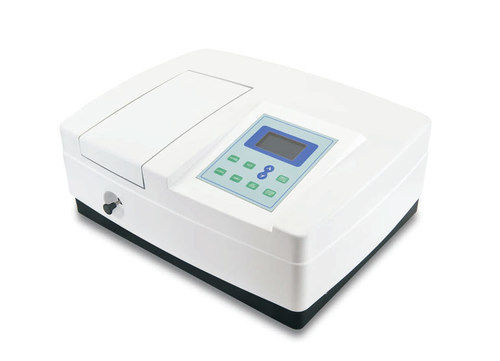
| | LOW STRAY LIGHT LMSP-UV1000B is made of high quality components with rigid structure which ensures low stray light |
| | STABILITY AND DURABILITY LMSP-UV1000B uses a rigid die-cast aluminum base as its optical mount to ensure instrument stability and Reliablity |
| | STRANDED CURVE LMSP-UV1000B can set up various standrad curves according to customer's solutions and final the concentration of unknown sloutions. |
| | MULTIPLE RESULTS READOUT LMSP-UV1000B can display wavelength, absorption and transmittance with 5 results per screen. It also has a memory store of up to 200 results |
| | AUTO SETTING WAVELENGTH Users can set wavelength automatically through arrow keys to avoid operation errors |
| | DATA OUTPUT LMSP-UV1000B is equipped with USB port to connected with a PC to display spectrum scanning, kinetics and multi wavelength testing results on the screen. The software is optional. |
| | Data can be restored after a sudden power cut. |
Versatile Laboratory ApplicationsIdeal for a wide spectrum of scientific work-including chemical, biological, pharmaceutical, and environmental testing-this UV-VIS spectrophotometer ensures consistent and reliable results across complex analyses. Its precision enables detailed assessments of solutions, making it an essential tool for research, quality control, and teaching laboratories. The single beam system and auto-zero function simplify daily operation and measurement repeatability.
Efficient and Intuitive OperationEquipped with an easy-to-use keypad and digital LCD display, the spectrophotometer offers streamlined workflows. Researchers can select scan speeds, auto-zero, and wavelength calibration settings quickly. The four-position cuvette holder allows for swift sample changes, minimizing downtime. Modern RS232 and USB connectivity enable seamless data transfer for further processing and storage on computers or laboratory networks.
Durable Design for Reliable PerformanceConstructed from high-quality ABS and metal, this spectrophotometer stands up to frequent laboratory use. Its compact, rectangular shape and moderate weight mean it fits conveniently on most laboratory benches. Designed to operate at ambient temperatures (15-35C) and humidity below 80%, it is robust enough for varied lab environments while maintaining peak accuracy and stability.
FAQ's of UV-VIS. Spectrophotometer (Single Beam):
Q: How does the single beam UV-VIS spectrophotometer operate?
A: This spectrophotometer uses a single beam optical system, passing light from deuterium and tungsten halogen lamps through a sample in a quartz cuvette. It measures the intensity of light before and after passing through the sample, then calculates absorbance for quantitative and qualitative analysis.
Q: What types of samples can be analyzed with this spectrophotometer?
A: It is compatible with samples placed in 10 mm quartz cuvettes, typically liquid solutions. Its applications include chemical analysis, biological assays, pharmaceutical formulations, and environmental testing, where UV-Vis absorption is used to determine concentrations or identify compounds.
Q: When should I calibrate the wavelength and perform auto-zero?
A: Wavelength calibration and auto-zero adjustment should be performed before starting a new set of measurements or when switching to different sample types, ensuring that accurate and reproducible data is obtained.
Q: Where is this spectrophotometer commonly used?
A: It is utilized in laboratories across chemistry, biology, pharmaceuticals, and environmental science sectors-frequently in research institutes, industrial quality control, and educational institutions throughout India and globally.
Q: What is the process for data output and storage?
A: Measured data can be exported via RS232 or USB interfaces, allowing easy transmission to computers or laboratory information systems for further analysis, documentation, or reporting.
Q: How does this device benefit laboratory workflows?
A: With features like a fast cuvette changer, selectable scan speeds, auto-zero, and digital controls, it enhances throughput and minimizes manual effort, ensuring efficient, precise, and reproducible results for high sample volumes.







 English
 Spanish
 French
 German
 Italian
 Chinese (Simplified)
 Japanese
 Korean
 Arabic
 Portuguese


 Send Inquiry

