Product Description
Travelling microscope:-
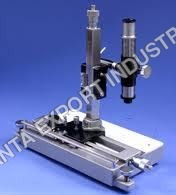
AIM Travelling Microscope consists of a cast iron base with machined-Vee-top surface and is fitted with three levelling screws. A metallic carriage, clamped to a spring loaded bar slides with its attached vernier and reading lens along an inlaid strip of metal scale. The scale is divided in half millimetres. Fine adjustments are made by means of a micrometer screw for taking accurate reading.
The Microscope, with its rack and pinion attachment is mounted on a vertical slide, which too, runs with an attached vernier along the vertical scale. The microscope is free to rotate n vertical plane. The vertical guide bar is coupled to the horizontal carriage of the microscope. for holding objects a horizontal stage made of a milki conolite sheet is provided in the base.
Specification:-
| Eye piece | Objectives |
| 10x | 15mm |
| 10x | 50mm |
| 10x | 75mm |
| Reading : | 0.01mm or 0.02mm |
Brand: - Ajanta
Precision Measurement for LaboratoriesThis Travelling Microscope is engineered for meticulous measurement tasks in laboratories, making it suitable for academic, research, and industrial settings. Its vernier scale with 0.01 mm least count and optical-grade glass objectives ensure reliable, high-resolution results. The adjustable stage and fine focusing capabilities provide flexibility and accuracy when observing small-scale changes and distances.
Versatile Construction and Robust MaterialCrafted from stainless steel, cast iron, and brass, the instrument's structure is built for longevity and stability. The powder-coated or enamel-painted base protects against corrosion, even in demanding laboratory environments. The high-precision micrometer screw and glass platform allow for smooth, steady movements and consistent performance.
Easy Manual Control and CalibrationDesigned for manual operation, the microscope avoids reliance on external power sources. The coarse and fine adjustment knobs allow seamless focusing, while the vernier scale display facilitates straightforward, precise calibration. Its rotating head and horizontally and vertically adjustable stage support a wide variety of measurement and observation tasks.
FAQ's of Travelling Microscope:
Q: How do I use the fine and coarse adjustment knobs on this travelling microscope?
A: To achieve optimal focus, start with the coarse adjustment knob to bring your specimen into general view, then switch to the fine adjustment knob for precise focusing. This dual mechanism allows for both swift and extremely accurate focusing during measurements or observations.
Q: What types of laboratory experiments benefit most from this microscope?
A: This microscope is ideal for physics experiments requiring precision measurements, such as the determination of refractive index, small displacement studies, or calibration of linear scales, thanks to its high accuracy (0.01 mm least count) and adjustable movement range.
Q: When should the vernier scale calibration be checked?
A: Verify and calibrate the vernier scale regularly before new experiments or whenever shifting the instrument's location. Routine calibration ensures measurement accuracy and reliability throughout its applications.
Q: Where can this travelling microscope be effectively used?
A: This microscope is best suited for laboratory environments in educational institutions, research facilities, or industrial quality control departments, especially where detailed optical measurements are required.
Q: What is the process for horizontal and vertical measurements?
A: Place the specimen on the glass platform and align it using the moving carriage. Adjust the main scale for gross positioning, then use the vernier scale and micrometer screw for fine, accurate horizontal or vertical readings as required by your experiment.
Q: What material advantages does this microscope offer?
A: Manufactured from durable materials such as stainless steel, brass, and cast iron, the microscope offers excellent corrosion resistance and stability, ensuring consistent results and a long operational lifespan under standard laboratory conditions.
Q: How does the manual control and lack of external power benefit users?
A: With manual adjustment mechanisms and no need for external power, this microscope is portable, reliable, and free from electronic maintenance issues, making it ideally suited for laboratories with limited access to electrical outlets or for field work.







 English
 Spanish
 French
 German
 Italian
 Chinese (Simplified)
 Japanese
 Korean
 Arabic
 Portuguese


 Send Inquiry

