Product Description
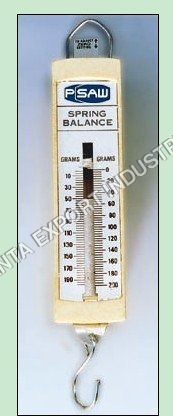
Flat form with zero and adjustable device with anodized metal scale. Metal parts richly plated in high impact polystyrene body. Suspension loop at top and load hook at the lower head. Individually packed in a beautiful cardboard box.Cat. No. | Capacity |
1) | 50 gms |
2) | 100 gms |
3) | 250 gms |
4) | 500 gms |
5) | 1000 gms
|
Precision in Every MeasurementEngineered for precise force and weight readings, the Spring Balance Metric allows users to obtain quick and accurate results. Its graduation in both Newtons and grams caters to a variety of laboratory tasks, while color-coded pointers enhance usability. This tool is a staple for science classrooms and professional labs where reliability is essential.
Built for Durability and ClarityCrafted with a robust combination of wood and steel along with quality plastic components, this spring balance stands up to rigorous usage. The scale markings-either printed or engraved-remain clear even after repeated use, while the cylindrical metal body and stainless steel hook ensure longevity.
Adaptable for Educational and Laboratory NeedsWith model options available for maximum capacities from 5N to 50N, the Spring Balance Metric meets diverse experimental requirements. Manual operation and easy-to-read pointers empower users to perform straightforward and repeatable measurements, making this tool indispensable in both teaching and research scenarios.
FAQ's of Spring Balance Metric:
Q: How should I use the Spring Balance Metric to measure force or weight accurately?
A: To measure force or weight, attach the item to the stainless steel hanging hook and ensure the balance is suspended vertically. The pointer will indicate the reading on the engraved or printed metric scale (Newtons or grams). For best accuracy, avoid side pulling and read the pointer at eye level.
Q: What types of experiments or activities is this spring balance suitable for?
A: This spring balance is ideal for laboratory measurements in educational settings, such as physics experiments to demonstrate Hooke's law, measure friction, or determine the mass and weight of objects. It is also suited for basic force measurements in professional laboratories.
Q: When should I choose a specific model capacity (5N, 10N, 20N, or 50N)?
A: Select the model based on the maximum force or weight you expect to measure. For lightweight tasks, the 5N or 10N models provide greater sensitivity, while the 20N and 50N options are better for heavier items or higher forces.
Q: Where should the Spring Balance Metric be stored to maintain its accuracy?
A: Store the spring balance in a clean, dry environment away from extreme temperatures (ideally within -10C to +50C). Avoid exposure to corrosive chemicals or humidity, and keep the instrument upright or hanging to prevent any spring deformation.
Q: What is the process for reading measurements with this instrument?
A: Hang the object from the hook, wait for the pointer to stabilize, and then read the value indicated on the Newton or gram scale. The color-coded pointer indicates different capacity ranges, making identification easier.
Q: What are the key benefits of using this spring balance in laboratory settings?
A: The main benefits include high sensitivity, reliable 1% accuracy, robust construction, and clear, easy-to-read graduation with color-coded indicators. Its manual operation and durable materials make it ideal for repeated educational and measurement uses.
Q: How does the temperature resistance feature impact usability?
A: With operational durability from approximately -10C to +50C, the spring balance remains dependable across standard laboratory and classroom conditions, ensuring consistent accuracy and performance in various environments.







 English
 Spanish
 French
 German
 Italian
 Chinese (Simplified)
 Japanese
 Korean
 Arabic
 Portuguese


 Send Inquiry

