Product Description
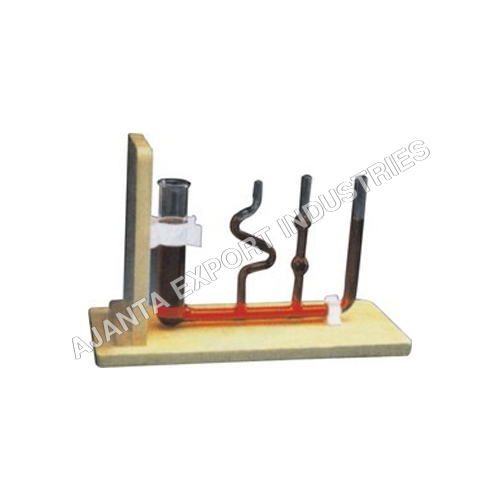
To show that the level of liquid in communicating vessels is constant irrespective of the size or shape of the vessels. The apparatus comprises four glass tubes of different shapes and cross sectional area projecting vertically from a common horizontal tube. The tubes are mounted on a polished wooden base. Reliable Laboratory DemonstrationsWith four distinct borosilicate glass tubes mounted on a sturdy, powder-coated stand, this apparatus offers a clear and effective way to demonstrate liquid level principles in the physics laboratory. The transparent design and graduated scales help instructors and students easily visualize and measure liquid behavior under various conditions.
User-Friendly and Safe DesignThis apparatus can be assembled on any bench-top and includes edge protection for glass parts. Rubber tubing and clamps simplify setup while the leak-proof joints ensure accuracy and cleanliness during demonstrations. It operates without the need for electrical power, making it both efficient and safe for classroom environments.
Durable and Accurate ConstructionManufactured using corrosion-resistant materials such as borosilicate glass, wood, and plastic, the apparatus withstands everyday laboratory use and resists temperature up to 110C. Its robust construction, combined with export-quality packaging and compliance with ISI standards, ensures reliability and long service life.
FAQ's of Liquid Level Apparatus:
Q: How does the Liquid Level Apparatus function in a laboratory setting?
A: The apparatus uses four vertically mounted borosilicate glass tubes of different diameters to visually demonstrate and measure the equalization of liquid levels across connected vessels, following the fundamental principles of hydrostatics. Fill the tubes with liquid, and the positions on the graduated scales illustrate the interactions.
Q: What advantages does this apparatus provide for laboratory experiments?
A: This apparatus offers accurate, hands-on demonstrations of liquid level concepts with a graduated scale accuracy of 1 mm. Its manual operation, safety provisions like edge protection, and corrosion-resistant stand enable repeated, reliable use in educational environments.
Q: When should this apparatus be used during laboratory demonstrations?
A: This equipment is best utilized in physics lessons focusing on fluid mechanics, particularly when illustrating liquid level principles between communicating vessels. It is appropriate for both introductory and advanced laboratory experiments.
Q: Where can the Liquid Level Apparatus be installed, and what is its mounting method?
A: It is designed for bench-top installation in laboratories. The rectangular stand ensures stability and the supplied clamps and rubber tubing make assembly straightforward on standard laboratory benches.
Q: What steps are involved in assembling and using the apparatus?
A: Place the stand on a flat surface, mount the glass tubes using the included clamps, attach the rubber tubing as needed, and ensure secure, leak-proof connections. Fill each tube with the designated liquid and use the graduated scale to observe and record results.
Q: Why is borosilicate glass used for the tubes, and what benefits does it offer?
A: Borosilicate glass is chosen for its high chemical resistance, durability, and ability to withstand temperatures up to 110C. It reduces breakage risks and ensures accurate, clear measurements during experiments.







 English
 Spanish
 French
 German
 Italian
 Chinese (Simplified)
 Japanese
 Korean
 Arabic
 Portuguese


 Send Inquiry

