Product Description
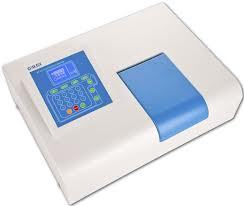
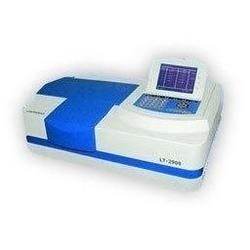
Single Beam Spectrophotometer
AJANTA EXPORT INDUSTRIES are manufacturer, supplier and Exporter of Single Beam Spectrophotometer.
Technical Specifications:
| Optical System | Single Beam, Grating 1200 lines/mm |
| Wavelength Range | 200-1000nm |
| Band Width | 1 nm |
| Wavelength Accuracy | 0.5 nm |
| Wavelength Repeatability | +0.1nm |
| Wavelength Setting | Automatic |
| Photometric Accuracy | 0.1 %T |
| Photometric Repeatability | +0.3 %T |
| Photometric Display Range | -0.3-3.0A,0-200%T, 0-9999C |
| Stability | +0.002A/h @ 500nm |
| Stray Light | 0.3%T @220nm, 360nm |
| Data Output Port | USB |
| Printer Port | Parallel Port |
| Display | 128*64 Dots LCD |
| Lamps | Deuterium Lamp & Tungsten Halogen Lamp |
| Detector | Silicon Photodiode |
| Power Requirement | AC220V/50 Hz |
Precision and Versatility for Lab ApplicationsIdeal for both clinical and research settings, this spectrophotometer covers a wide wavelength range (325-1000 nm) with high resolution (0.1 nm) and better than 0.5%T accuracy. Multiple cuvette compatibility and a sturdy build enhance its application range, supporting diverse tests in hospital and laboratory environments.
User-Friendly Operation and Robust DesignThe instrument offers intuitive controls, including a soft keypad and digital LCD display for streamlined workflow. Features like auto zero adjustment and a wavelength selection knob limit manual errors, while the compact, robust design allows for easy installation and reliable performance even with frequent use.
Stable and Reliable MeasurementsEngineered for stringent laboratory needs, the spectrophotometer maintains high stability (0.004A/h @ 500 nm) and excellent baseline flatness (0.002A/h @ 500 nm), ensuring trustworthy and repeatable results. This consistency is essential for both routine analyses and specialized research tasks.
FAQ's of Single Beam Spectrophotometer:
Q: How does the Single Beam Spectrophotometer ensure accurate and stable readings?
A: This spectrophotometer employs a tungsten lamp as the light source and a silicon photodiode detector, ensuring precise measurement within a spectral bandwidth of 5 nm. Features like auto zero adjustment, baseline flatness (0.002A/h @ 500 nm), and high stability (0.004A/h @ 500 nm) minimize drift and maintain measurement reliability over time.
Q: What types of analyses can be performed with this spectrophotometer in a laboratory setting?
A: The instrument is suitable for both quantitative and qualitative analyses, including absorbance, transmittance, and concentration measurements. Its broad wavelength and photometric range allow it to analyze a wide spectrum of compounds for medical, pharmaceutical, and research applications.
Q: When should I use quartz versus optical glass cuvettes with this equipment?
A: Quartz cuvettes are recommended for measurements in the UV range (below 400 nm), whereas optical glass cuvettes are sufficient for visible light analysis. Selecting the appropriate cuvette type enhances measurement accuracy based on your sample's wavelength requirements.
Q: Where can this spectrophotometer be utilized, and who commonly uses it?
A: This laboratory spectrophotometer is widely used in hospitals, clinical laboratories, research institutions, and quality control labs. It is commonly employed by medical technicians, laboratory scientists, and researchers for routine and advanced analytical work.
Q: How do I operate and adjust the wavelength on this spectrophotometer?
A: Wavelength selection is managed through a dedicated knob on the instrument, while operational controls are accessible via a soft keypad panel. The digital LCD display guides users through setup and adjustments, ensuring efficient use and minimal training requirements.
Q: What benefits does the digital LCD display provide during laboratory analysis?
A: The digital LCD display offers clear visualization of reading outputs and operating parameters, allowing users to track data in real time and make accurate adjustments. This promotes ease-of-use, reduces error risk, and improves overall lab productivity.
Q: What are the main advantages of the spectrophotometer's compact and robust design?
A: The compact dimensions (470 x 370 x 180 mm) and durable plastic/metal construction facilitate space-saving installation and withstand frequent laboratory handling. The design supports versatile cuvette sizes and maintains performance stability, making it practical for high-throughput environments.







 English
 Spanish
 French
 German
 Italian
 Chinese (Simplified)
 Japanese
 Korean
 Arabic
 Portuguese


 Send Inquiry

