Product Description
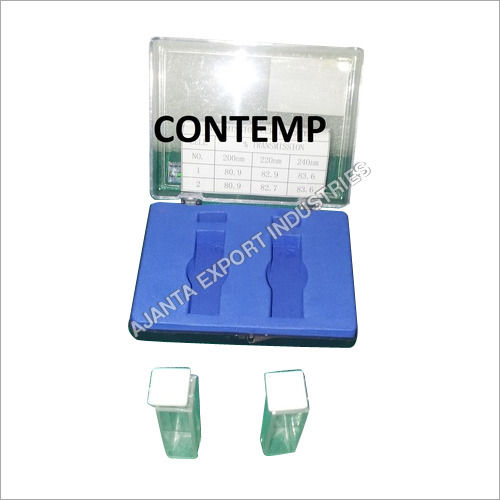
SET OF 2 QUARTZ CUVETTES 10MM CUVETTE CELL SPECTROMETER
One Matched Pair of Standard Quartz Cuvette (Open-top type, 10 mm light path, 3.5 mL volume): The cuvette has a fused quartz body and windows. It fits all standard UV-VIS spectrophotometers (such as Shimadzu, Perkin Elmer, GE, HP, and Beckman etc.). These cuvettes are designed for UV-VIS-NIR applications.
| Cell Material | Optical Quartz |
| Top Type | Open-top, Ptfe lid |
| Light Path | 10 mm |
| Cell Volume | 3.5 mL |
| Outside Dimensions | 45mm 12.5mm 12.5mm |
| Spectral range | 190-2000 nm |
Precision Optical PerformanceThese quartz cuvettes offer a tight pathlength tolerance of 0.01 mm, ensuring highly accurate readings for your spectroscopic or analytical procedures. The polished optical surfaces and four clear sides are ideal for maximizing light transmission and minimizing measurement errors.
Versatile Chemical and Temperature ResistanceBuilt from high-purity quartz glass, these cuvettes withstand temperatures up to 1100C and show excellent resistance to acids, bases, and organic solvents. Their durability makes them a reliable choice for routine laboratory use in diverse analytical environments.
Practical Laboratory FeaturesThe rectangular design allows easy handling, and the two frosted sides aid quick orientation within most spectrometers. Open tops are compatible with PTFE stoppers or caps (not included), supporting flexible sample management and straightforward cleaning, ensuring long-term reusability.
FAQ's of SET OF 2 QUARTZ CUVETTES 10MM CUVETTE CELL SPECTROMETER:
Q: How do I properly clean and maintain the quartz cuvettes after use?
A: Rinse the cuvettes immediately with appropriate solvents based on the sample type (water for aqueous solutions, organic solvents for organic samples), followed by distilled water. Avoid using abrasive materials; a gentle, non-abrasive cleaning brush can be used if necessary. Allow the cuvettes to air dry or gently wipe them with lint-free tissues.
Q: What are the benefits of using quartz glass over standard glass or plastic cuvettes?
A: Quartz glass offers superior optical clarity and transmits light across a broader spectrum (190-2500 nm), making these cuvettes suitable for UV, visible, and near-infrared applications. They also demonstrate excellent chemical and thermal resistance, allowing for repeated use and exposure to harsh reagents.
Q: When should I use these 10 mm pathlength quartz cuvettes in my laboratory work?
A: These cuvettes are ideal for spectroscopic measurements requiring standard 1 cm optical pathlengths, especially in quantitative UV-VIS-NIR analyses, absorbance or transmission experiments, or when working with samples that demand high resistance to chemicals or temperature extremes.
Q: Where can I use these cuvettes, and with which instruments are they compatible?
A: The cuvettes are intended for use in laboratory environments, fitting most UV-VIS and NIR spectrophotometers and analyzers designed for standard 10 mm pathlength rectangular cuvettes. Check your instrument's sample holder specifications for compatibility.
Q: What is the process for filling these cuvettes and ensuring accuracy during measurements?
A: Carefully fill the cuvette up to the fill line or graduation mark (approx. 3.5 mL for 10 mm pathlength). Avoid air bubbles by gently tapping the cuvette. Always use the clear optical sides for light entry and exit, ensuring the frosted sides are perpendicular to the beam for proper alignment.
Q: How does the open-top design benefit laboratory workflows?
A: The open-top cuvettes allow for easy sample addition and removal, as well as simple cleaning and drying procedures. For sensitive or volatile samples, a compatible PTFE stopper (not included) can be used to minimize contamination or evaporation during measurements.
Q: What makes these cuvettes a cost-efficient choice for labs?
A: Their durability, chemical resistance, and ease of cleaning mean that these cuvettes can be used repeatedly in various analytical setups. This reusability reduces the need for frequent replacements, lowering overall laboratory consumable costs.







 English
 Spanish
 French
 German
 Italian
 Chinese (Simplified)
 Japanese
 Korean
 Arabic
 Portuguese


 Send Inquiry

