Product Description
Specifications:| General Range | Serum Range | Urine Range |
| (ppm) | (meq) | (meg) | (meg) |
| Na: 0-100 | Up to 250 meq/l
|:100dil. | 0-200 meq/l
|:100dil.
| 0-250 meq/l
|:100dil.
|
| K: 0-100 | Up to 250 meq/l
|:100dil. | 0-10 meq/l
|:100dil.
| 0-10 meq/l
|:100dil.
|
| Li:0-100 | Up to 250 meq/l
|:100dil. | 0-2 meq/l
|:5dil.
| ---------- |
| Ca: 0-100 | Up to 250 meq/l
|:100dil. | ----------- | 0-10 meq/l
|:2dil.
|
| Sensitivity | General mode: Na:2 ppm, K:1 ppm,Li:1 ppm,Ca:30
ppm
|
|
|
| Filters | Na & K Supplied (Ca & Li are optional at extra cost) |
| Resolution | 0.1 ppm/meq |
| Reproducibility | ±2%FS±2 digits |
| Curve fit accuracy | ±2% of FS |
| Display | 20x4 character Alphanumeric LCD display |
| Average time | In-built in Software |
| Flame system | LPG and dry oil free air |
| Detector | Photodiode |
| Calibration | Up to 5 points Calibration with Curve Fitting Software |
| Gas control | Adjustable with knob |
| Ignition System | Auto ignition |
| Combustion gas | LPG |
| Atomizer | Axial flow type |
| Printer | Provision for attachment of printer |
| RS 232 interface | Available (PC software at extra cost) |
| Air compressor | With Built-in regular to deliver stable and moisture/oil
free air supply |
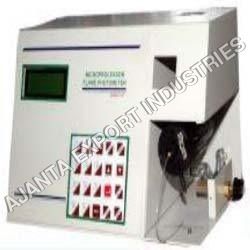
Engineered for dependability, the Microprocessor Flame Photometer delivers high-precision analysis of sodium, potassium, calcium, and lithium, catering to strict laboratory standards. Its microprocessor-controlled calibration and detection systems enable rapid, repeatable measurements with exceptional sensitivity. The inbuilt oil-free compressor and flame safety interlock provide smooth, safe operation over a wide range of laboratory applications in research, environmental monitoring, and industry.
User-Friendly Interface and AutomationThis flame photometer stands out with its intuitive microprocessor-based controls, featuring automatic calibration and a bright LED digital display for immediate, error-free readings. The system supports direct data output via printer port or RS-232, offering easy integration with laboratory information systems. Its user-friendly design ensures minimal operator training and consistent, efficient workflow, making it suitable for routine analysis in diverse sample environments.
Robust Safety and Efficient ConstructionPrioritizing safety and reliability, this photometer features fully automatic ignition, flame failure detection, and an automatic gas cut-off system. Built with stainless steel, powder-coated casing, and a corrosion-resistant nebulizer, the design withstands intensive laboratory use and harsh chemical exposure. Its compact, rectangular footprint and built-in compressor make it efficient and space-saving, ideal for any laboratory setting.
FAQ's of Microprocessor Flame Photometer:
Q: How does the automatic calibration feature of the Microprocessor Flame Photometer work?
A: The flame photometer uses a microprocessor to perform automatic calibration before each measurement. This function ensures accuracy and repeatability by adjusting the instrument's response to reference standards for sodium, potassium, calcium, and lithium, eliminating manual intervention and reducing the risk of user error.
Q: What is the process for analyzing a sample with this flame photometer?
A: To analyze a sample, introduce 2-3 ml of the prepared sample into the nebulizer. The instrument aspirates the sample (5-6 ml/min), and the elements are detected by dedicated photo detectors. The result is displayed instantly on the 4-digit LED and can be printed or exported via RS-232. Calibration and ignition are automatic, streamlining the workflow.
Q: Where can this flame photometer be used effectively?
A: This instrument is ideal for laboratory settings involved in clinical, environmental, agricultural, or industrial analyses-such as research labs, soil testing facilities, fertilizer manufacturing, and chemical quality control departments-across India and globally.
Q: When should you perform maintenance on this photometer?
A: Routine maintenance should be conducted based on usage frequency, typically every few months. Regular cleaning of the nebulizer and mixing chamber, inspection of gas supply connections, and checking the built-in air compressor will ensure optimal performance and longevity.
Q: What safety features are integrated in the equipment?
A: The photometer is equipped with automatic flame failure detection, gas cut-off safety interlock, and electronic automatic ignition. These safeguards protect the user and laboratory from accidental gas leaks or flame-out incidents, ensuring secure operation.
Q: How does the equipment benefit laboratory workflows?
A: By combining automatic calibration, digital display, rapid data output, and minimal sample requirement, the photometer enhances laboratory efficiency, accuracy, and throughput. Its microprocessor controls reduce operator workload, enabling high-throughput and reliable elemental analysis.
Q: What types of gas are suitable for operating the flame photometer?
A: The instrument is compatible with LPG or Propane as the gas supply, providing flexibility and availability, and allowing safe operation within standard laboratory protocols.







 English
 Spanish
 French
 German
 Italian
 Chinese (Simplified)
 Japanese
 Korean
 Arabic
 Portuguese


 Send Inquiry

