Product Description
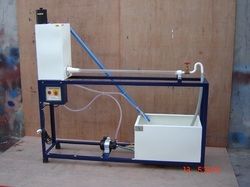
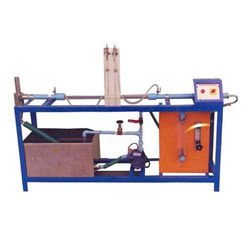
The apparatus consists of a glass tube with one end having bell mouth entrance; connected to a constant headwater tank, at the other end a valve is provided to vary the flow rate. The tank is of sufficient capacity to store water; A capillary tube is introduced centrally in the bell mouth for feeding dye from a small container placed at the top of tank, through polythene tubing. By varying the rate of flow, the Reynold's number is changed; this also changes the type of flow. Visual observation of dye (Thread) will indicate the type of flow, which can be confirmed from the Reynold's number computed. Present set-up is self-contained water re-circulating unit, provided with a sump tank and a centrifugal pump etc. Flow control valve and by-pass valve are fitted in water line.
Flow rate of water is measured with the help of measuring cylinder and stop watch.
Experiments
- To determine the Reynold's number and hence the type of flow either laminar or turbulent
Engineered from stainless steel, the Reynolds Apparatus offers superior durability and resistance to corrosion, making it suitable for rigorous laboratory usage. Its robust architecture supports precise and consistent experimentation, ensuring reliable results across a broad range of laboratory settings.
Adaptable to Various Laboratory RequirementsThe apparatus is designed to operate seamlessly within standard laboratory voltage ranges (110-220 Volt) and low temperature conditions (0-5C). Its adaptability makes it an excellent choice for educational institutes and research facilities focusing on fluid dynamics and hydrodynamics studies.
FAQ's of Reynolds Apparatus:
Q: How does the Reynolds Apparatus work in a laboratory setting?
A: The Reynolds Apparatus is used to study fluid flow patterns by injecting colored dye into a fluid within a tube and observing its behavior under controlled flow rates. This allows students and researchers to distinguish between laminar, transitional, and turbulent flows.
Q: What materials are used in the construction of the Reynolds Apparatus?
A: This apparatus is constructed entirely from high-grade stainless steel, enhancing its longevity, resistance to corrosion, and suitability for repeated laboratory use.
Q: When should the Reynolds Apparatus be used in experiments?
A: It should be used when studying the principles of fluid mechanics, particularly to demonstrate the concept of Reynolds Number and to visualize different types of flow in fluids.
Q: Where is the Reynolds Apparatus manufactured and supplied from?
A: The apparatus is manufactured, exported, distributed, and supplied by reputable companies based in India, serving both domestic and international laboratory markets.
Q: What is the process of conducting an experiment with the Reynolds Apparatus?
A: To conduct an experiment, set up the apparatus, fill it with fluid, and adjust the voltage as needed. Inject dye and gradually increase the flow rate while observing the dye's movement to identify flow regimes.
Q: What are the main uses and benefits of the Reynolds Apparatus?
A: The main use is to visually identify flow patterns, which aids in teaching and research in fluid dynamics. Its benefits include ease of operation, durable design, and accurate demonstration of key fluid mechanics concepts.







 English
 Spanish
 French
 German
 Italian
 Chinese (Simplified)
 Japanese
 Korean
 Arabic
 Portuguese


 Send Inquiry

