Product Description
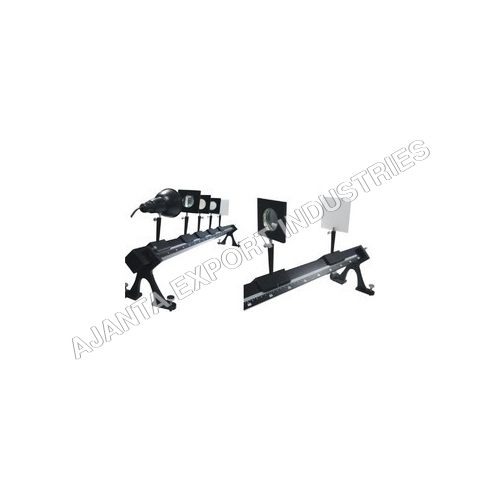
Comprising a wooden baseboard 1.1mx115mm. with a 1m scale divided in millimeters and figured every centimeters, fixed along the front edge and complete with the following accessories:
2 White-face object & receiving screens each comprising a white card having an aperture and index, in a black metal frame 150x100mm with an index mark at the end.
1 plane mirror 150x100mm mounted on a wooden base as above.
4 Lens holders, each comprising a wooden upright with
a V shaped slot to hold lenses up to 75mm, diameter, mounted on a wooden base 100x50mm with an index line at the end.
1 Needle mounted vertically in a short wooden rod in the center of a wooden base 100x50mm.
1 candle holder.
The optical center height of all the components is 100 mm above the base board. Durable Construction for ReliabilityCrafted with a powder-coated cast iron base and finished with anodized aluminum riders, this optical bench ensures long-term durability. Anti-slip pads increase operational stability, making it suitable for demanding laboratory environments where safety and precision are essential.
Precision and FlexibilityFeaturing a stainless steel scale graduated at 1 mm intervals and smooth, lockable riders, users can achieve highly accurate measurements. The 1-meter length and flexible mounting options for optical components allow the bench to be adapted for various experimental setups and investigations.
FAQ's of Optical Bench:
Q: How is the optical bench used in laboratory settings?
A: The optical bench is used for precise positioning and measurement of optical components such as lenses, mirrors, and screens during physics experiments, enabling students and researchers to study image formation, lens properties, and light behavior.
Q: What are the benefits of the 1 mm graduated scale and anodized aluminum riders?
A: The 1 mm graduated scale ensures millimeter-level measurement accuracy, while the anodized aluminum riders facilitate smooth, adjustable, and stable positioning of mounted optical components for reliable experimental results.
Q: Which environments are suitable for using this optical bench?
A: This optical bench is specifically designed for use in school, college, and research laboratories, where controlled experiments related to optics are conducted.
Q: How do the anti-slip pads and heavy cast iron base enhance stability?
A: The anti-slip pads and solid cast iron base prevent unwanted movement or vibrations during adjustments, maintaining experimental accuracy even in busy laboratory environments.
Q: When should the optional lamp or accessories be used with the optical bench?
A: The optional lamp, lens holder, slit, mirror, and screen can be attached when demonstrations require specific optical setups, such as studying light refraction, reflection, or image formation with varied sources and components.
Q: What is the process for mounting optical components onto the bench?
A: Components are easily attached by positioning them on the riders using the provided mounting options, then locking the riders in place with thumb screws to enable precise experimental alignment and measurements.
Q: What are the main advantages of manual control and analog display in this instrument?
A: Manual adjustments and analog scales provide hands-on understanding and direct observation of experimental changes, fostering deeper learning and precise control during optical experiments.







 English
 Spanish
 French
 German
 Italian
 Chinese (Simplified)
 Japanese
 Korean
 Arabic
 Portuguese


 Send Inquiry

