Product Description
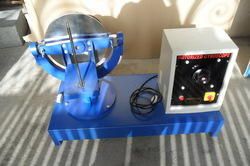
The set up consists of heavy disc mounted on a horizontal shaft, rotated by a variable speed motor. The rotor shaft is coupled to a motor mounted on a trunion frame having bearings in a yoke frame, which is free to rotate about vertical axis. A weight pan on other side of disc balances the weight of motor. Rotor disc can be move about three axis. Torque can be applied by calculating the weight and distance of weight from the center of rotor. The gyroscopic couple can be determined.
Experiments
- Experimental justification of the equation T = 1 w. wp for calculating the gyroscopic couple by observation and measurement of results for independent vibrations in applied couple T and precession wp.
- To study the gyroscopic effect of a rotating disc
- Observation of gyroscopic effect of rotating disc
Utilities Required
- Electric supply: 230 V AC, Single Phase.
- Bench area: 1m x 1m
Precision Engineering for Educational ExcellenceThis motorized gyroscope is meticulously constructed using high-quality stainless steel and a durable cast iron base to ensure long-lasting performance and stability. Designed specifically for laboratory environments, the gyroscope features a flywheel diameter of 225 mm and a variable speed motor, making it an essential tool for clear and accurate demonstrations of rotational dynamics and gyroscopic behavior.
User-Friendly Operation and VersatilityEquipped with variable speed control and simple levelling features, this gyroscope allows users to conveniently adjust experimental parameters. The heavy base and well-marked graduations make setup and data collection efficient, while included accessories such as weights and string expand the scope of possible experiments for students and educators alike.
Comprehensive Laboratory ApplicationWith its robust build and reliable fractional horsepower motor, this educational gyroscope enables various demonstrations in colleges, universities, and research labs. It operates efficiently on standard 110-220V AC power and is optimized for room temperature conditions, supporting practical experiments in angular momentum, precession, and torque.
FAQ's of Motorized Gyroscope:
Q: How is the motorized gyroscope used in a laboratory setting?
A: The motorized gyroscope is utilized to demonstrate and study gyroscopic principles such as angular momentum, precession, and nutation. It's mounted on a stable cast iron base, and users can adjust the speed using the variable control to observe different rotational dynamics. Accessories like weights and string allow for diverse experimental setups in a classroom or research environment.
Q: What components and accessories are included with the gyroscope?
A: The package comprises the main gyroscope unit with a 225 mm stainless steel flywheel, a sturdy cast iron base with levelling screws, a fractional HP electric motor, variable speed controls, and clearly marked graduations. Additionally, a set of weights and string is included to support various laboratory experiments.
Q: When is the ideal time to use this equipment in an educational laboratory?
A: This gyroscope is best employed during physics experiments or demonstrations focusing on rotational motion, angular momentum, or when studying gyroscopic effects. It's suitable for lessons on dynamics or for research activities requiring precise control over rotational parameters.
Q: Where can this motorized gyroscope be installed or operated?
A: Designed for laboratory environments, it should be placed on a sturdy, level surface where the levelling screws can ensure stable operation. It's ideal for use in schools, colleges, technical institutes, and research laboratories requiring demonstrations or practical work on gyroscopic principles.
Q: What is the process of adjusting the speed and conducting measurements?
A: Speed is controlled via the variable speed feature on the electric motor, allowing adjustments up to 4000 rpm (10%). The clear graduations on the gyroscope frame support precise angle and position measurements, while the included weights and string facilitate various experiment procedures.
Q: How does using this gyroscope benefit laboratory instruction?
A: It provides hands-on experience and visual demonstration of complex concepts like angular momentum and torque, making lessons more engaging and improving student understanding. The sturdy construction and reliable components ensure repeatable, accurate results for both teaching and research purposes.







 English
 Spanish
 French
 German
 Italian
 Chinese (Simplified)
 Japanese
 Korean
 Arabic
 Portuguese



 Send Inquiry

