Product Description
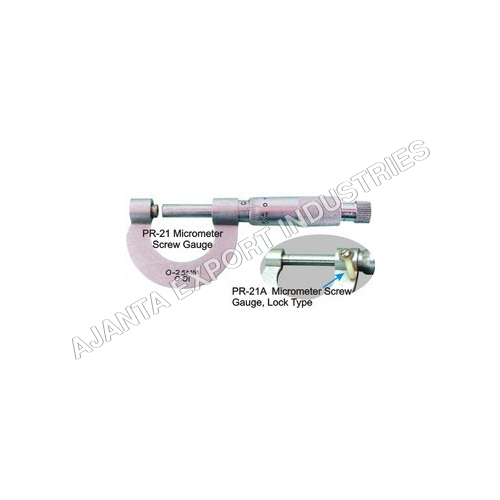
Made of nickle plated brass, with ratchet top, accurately machined stainless steel rod, supplied in plastic case.
| Specification :- | Micrometer (Screw Gauge) |
| Range | 0-25 x 0.001 mm |
| Made | Nickle Plated Brass |
| Make | Ajanta |
Precision and Durability CombinedBuilt for consistent measurements, this screw gauge features carbide-tipped faces and a hardened steel spindle, providing exceptional wear resistance and longevity. The rugged frame is finished with corrosion-resistant enamel, ensuring stability and reliability even in demanding environments. Designed for laboratory and industrial use, it offers precision and durability in a single instrument.
User-Friendly and Versatile DesignThe micrometer's analog vernier scale is etched for readability, allowing quick, precise adjustments. Its ergonomic shape, with a rectangular frame and cylindrical spindle, fits comfortably in hand. The screw-type lock nut ensures readings remain steady, and manual operation means no external power is required, maximizing convenience and portability.
FAQ's of Micrometer (Screw Gauge):
Q: How do you use the micrometer screw gauge to measure an object?
A: To measure with the micrometer, place the object between the carbide-tipped faces, then carefully rotate the thimble until it gently contacts the object. Use the ratchet stop to prevent excessive force. Lock the position with the screw-type nut, and read the measurement from the analog vernier scale for high accuracy.
Q: What applications is this micrometer best suited for?
A: This micrometer screw gauge is ideal for laboratory and industrial applications requiring precise measurement of small components, material thickness, and diameters. Its high resolution and robust build make it suitable for quality control, machining, and research environments.
Q: When should the screw-type lock nut be used during measurements?
A: The screw-type lock nut should be used once you have positioned the measuring faces in contact with the object and reached the desired measurement. Engaging the lock nut secures the spindle, ensuring your measurement remains accurate while you take the reading.
Q: Where can this micrometer be used effectively?
A: This instrument can be effectively used in laboratories, manufacturing facilities, workshops, and educational settings. Its manual operation makes it versatile for various environments that require no electrical power, and it is particularly suitable for the measurement of precise mechanical parts.
Q: What benefits do the carbide-tipped measuring faces provide?
A: Carbide-tipped measuring faces significantly enhance wear resistance, providing extended tool life and maintaining consistent accuracy even after repeated use. This feature is especially advantageous in high-use environments such as laboratories and industrial workshops.
Q: How is accuracy ensured with this screw gauge?
A: Accuracy is achieved through the finely etched metric scale, precision-ground spindle, and wear-resistant carbide measuring faces. The ratchet stop controls the measuring force, ensuring reliable and repeatable readings to within 0.01 mm accuracy.
Q: What materials make up the frame and spindle of the micrometer?
A: The frame is constructed from cast iron for rigidity and durability, while the spindle is made of hardened steel for strength and precision. The combination of these materials ensures both stability and precise performance.







 English
 Spanish
 French
 German
 Italian
 Chinese (Simplified)
 Japanese
 Korean
 Arabic
 Portuguese


 Send Inquiry

