Product Description
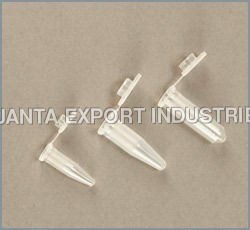
Features- Major Uses: Molecular Biology & Biochemistry.
- Processed through Highest quality of Virgin Polypropylene.
- Can be used in very low temperature and with Organic Solvents.
- These tubes are with Integral Snap Cap.
- Frosting on the surface makes writing easier.
- Can be Autoclaved.
- Maximum RCF 2000.
- Large Mounded in graduations makes identification easy.
- These Tubes are RNase, DNase and Pyrogen Free.
Micro Centrifuge Tubes, PP| Code | Capacity (ml) | Outer Diameter (mm) | Height (mm) | No. Per Case |
| P10201 | 0.5 | 10 | 31.5 | 1000 |
| P10202 | 1.5 | 13 | 41 | 500 |
| P10204 | 1.5 Coloured | 13 | 41 | 500 |
| P10204A | 1.5 Amber | 13 | 41 | 500 |
| P10203 | 2.0 | 13 | 41 | 500 |
*P10204 is available in Red, Blue, Yellow and Green. Clear Graduation and Reliable SealingEach micro centrifuge tube has precise graduation markings for easy and accurate sample measurement, ensuring reliable experimental results. The attached, hinged snap-fit cap guarantees leak-proof sealing, preventing contamination and sample loss during centrifugation or storage.
Durable and Versatile Laboratory UseManufactured from high-grade polypropylene, these tubes provide outstanding chemical and temperature resistance, making them ideal for autoclaving, freezing, and use with a broad range of substances. Their conical design supports efficient sample collection and retrieval for a variety of laboratory workflows.
FAQ's of Micro Centrifuge Tubes, PP:
Q: How should Micro Centrifuge Tubes be used in laboratory workflows?
A: Micro Centrifuge Tubes are typically used for preparing, centrifuging, and temporarily storing small sample volumes of liquids. Ensure tubes are capped securely, loaded evenly into your micro centrifuge, and used within their specified speed (up to 20,000 x g) and temperature (-80C to 121C) ranges for optimal safety and performance.
Q: What benefits do the clear graduation markings provide?
A: The clear, accurate graduation markings on each tube enable precise measurement of sample volumes, reducing the risk of pipetting errors and ensuring reproducibility in laboratory procedures.
Q: When is it recommended to use the sterile versus non-sterile option?
A: Choose sterile tubes for applications involving cell culture, sensitive assays, or nucleic acid work, where contamination must be minimized. Non-sterile versions are appropriate for routine processes that are less sensitive to contamination, such as sample storage or general mixing.
Q: Where can these micro centrifuge tubes be used?
A: They are suitable for use in most research, clinical, and industrial laboratories equipped with standard micro centrifuges. Their design ensures compatibility with common centrifuge rotors and racks.
Q: What is the process for disposing of used Micro Centrifuge Tubes?
A: Since these are single-use consumables, dispose of them in accordance with your laboratory's biohazard and chemical waste disposal protocols after use-particularly if they have contained hazardous or biological materials.
Q: How do the tubes maintain sample integrity during centrifugal force?
A: The leak-proof, hinged snap-fit cap and robust polypropylene construction ensure the tubes remain securely closed and intact even at high speeds, protecting your samples from leakage, evaporation, or contamination during centrifugation.







 English
 Spanish
 French
 German
 Italian
 Chinese (Simplified)
 Japanese
 Korean
 Arabic
 Portuguese


 Send Inquiry

