Product Description
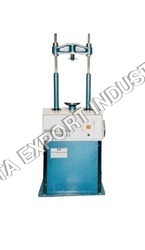
Capacity is of 10,000 Kgf having two telescopic pillars and an adjustable crosshead. Limit switches are fitted inside to control upward or downward movement of the pillars. On-off reversing switch and Indicator lamps are fitted on the front side, while a hand wheel to manually move the pillars isfixed at the right side of the unit. The load frame has a fix speed of 5.08 cm / min. Operated on 230 Volts, AC Supply.Robust Rigid Frame for Accurate TestingConstructed from high-quality stainless steel, the rigid frame of the Marshall Stability Test Apparatus ensures stable and repeatable results during bituminous mix stability assessments. The rigid nature, complemented by a user-friendly lifting handle, guarantees easy mobility without compromising structural integrity.
Versatile Loading System up to 50 kNWith a load capacity of up to 50 kN (5000 kg), the apparatus is suitable for thorough testing of a wide range of specimen types commonly encountered in asphalt and bituminous applications. The proving ring and adjustable loading rate (50 mm/min) allow for precise load application based on various testing requirements.
Comprehensive Accessories and ComplianceSupplied with breaking head, base plate, extension rods, sample extractor, and compaction hammer, the apparatus provides all tools necessary for standard-compliant testing. Fully aligned with ASTM D6927 and IS 1207, this system ensures accuracy and reliability in every analysis for laboratories and research facilities.
FAQ's of Marshall Stability Test Apparatus:
Q: How does the Marshall Stability Test Apparatus operate manually?
A: The apparatus is designed for manual operation, employing a hand-driven mechanism to apply load through the proving ring at an adjustable rate of 50 mm/min. Users control the loading process while observing deformation on the dial gauge, allowing for precise monitoring in line with standardized test methods.
Q: What are the key benefits of using this apparatus in a laboratory setting?
A: This apparatus offers high accuracy thanks to its rigid stainless steel frame and precise dial gauge (0.01 mm graduation), ensuring reliable and repeatable results. Its compliance with ASTM D6927 and IS 1207 makes it ideal for research, quality control, and educational purposes in labs or hospitals.
Q: When should the Marshall Stability Test Apparatus be used during bituminous mix analysis?
A: The apparatus is employed during the mix design phase and quality assessment of asphalt materials. It is typically used after specimen compaction and prior to construction to evaluate the stability and flow properties, ensuring materials meet required standards for pavement performance.
Q: Where is this Marshall Stability Test Apparatus commonly utilized?
A: This apparatus is widely utilized across civil engineering laboratories, road construction companies, research institutions, universities, and even hospital labs involved in material testing throughout India and globally, wherever high-precision bituminous testing is required.
Q: What is the process for conducting a Marshall stability test with this equipment?
A: First, prepare and compact the bituminous mixture using the supplied mould and compaction hammer. Heat the sample in the 30-liter bath, then place it between the breaking heads on the apparatus. Gradually apply load at 50 mm/min while monitoring the dial gauge and proving ring readings to determine stability and flow values.
Q: Which test standards does this apparatus comply with?
A: The apparatus is engineered in full compliance with ASTM D6927 and IS 1207 test methods, ensuring it meets international and national standards for Marshall stability testing of bituminous mixtures used in road and pavement construction.







 English
 Spanish
 French
 German
 Italian
 Chinese (Simplified)
 Japanese
 Korean
 Arabic
 Portuguese


 Send Inquiry

