Product Description
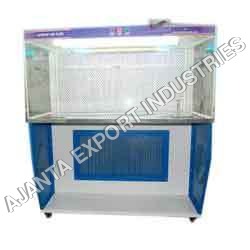
Laminar Air Flow Cabinets
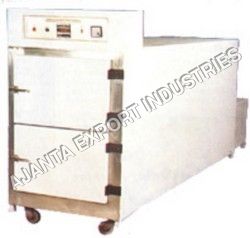
The highly appreciated Laminar Air Flow Cabinets are fabricated using premium quality raw material. An efficiency of 99.997% down to 0.3% microns along with appropriate motor blowing assembles these cabinets are completed with HEPA filter. With attractive epoxy powder coating finish and GMP model these cabinets are available in metallic construction.
Some of the technical specifications of these cabinets are:
| MODEL TYPE | HM-2/VM-2 | HM-3/VM-3 | HM-4/VM-4 |
| Working Area | 2 x 2 x 2 | 3 x 2 x 2 | 4 x 2 x 2 |
| Size of the Filter | 2 x 2x 6 | 3 x 2 x 6 | 4 x 2 x 6 |
| HEPA FILTER (with unit) | One | One | One |
| PRE-filter (with unit) | One | One | One |
| Illumination (with unit) | 1 x 20 watts | 2 x 20 watts | 2 x 40 watts |
Blank
| Model Type | HM-6/VM-6 | HM-8/VM-8 |
| Working Area | 6 x 2 x 2 | 8 x 2 x 2 |
| Size of the Filter | 3 x 2 x 6 | 4 x 2 x 6 |
| HEPA Filter (with unit) | Two | Two |
| PRE-Filters (with unit) | Two | Two |
| Illumination (with unit) | 2 x 40 watts | 4 x 40 watts |
Laminar Air Flow Cabinets ensure a consistently clean workspace by filtering and directing air away from contaminants. Their robust metal construction and efficient air filtration make them ideal for laboratory tasks such as sample preparation, media pouring, and sensitive equipment handling. By maintaining a particle-free environment, these cabinets enhance the reliability and safety of laboratory procedures.
Ease of Integration and OperationDesigned for straightforward installation and operation, Laminar Air Flow Cabinets run on a standard 220 Volt power supply. Their intuitive controls allow laboratory personnel to maintain proper air flow with minimal training. Available across India through a network of distributors and suppliers, these cabinets can be seamlessly integrated into new or existing laboratory setups.
FAQ's of Laminar Air Flow Cabinets:
Q: How does a Laminar Air Flow Cabinet work in laboratory settings?
A: A Laminar Air Flow Cabinet operates by drawing air through HEPA filters and then directing the purified air in a uniform, laminar flow across the work area. This process creates a sterile environment, protecting samples and equipment from airborne contaminants.
Q: What are the main applications of Laminar Air Flow Cabinets in laboratories?
A: These cabinets are primarily used for sterile procedures, such as microbiology, tissue culture, and pharmaceutical work, where contamination control is essential. They are also suitable for sample preparation, media pouring, and handling sensitive equipment.
Q: When should I choose a Laminar Air Flow Cabinet for my laboratory?
A: You should opt for a Laminar Air Flow Cabinet when your work requires a particle-free environment, especially for tasks involving non-hazardous materials. They are ideal when precise contamination control is needed during sample handling or experimental setup.
Q: Where can I purchase Laminar Air Flow Cabinets in India?
A: Laminar Air Flow Cabinets are widely available in India through experienced distributors, exporters, manufacturers, suppliers, and traders. This extensive network ensures that laboratories throughout the country can access reliable equipment quickly and efficiently.
Q: What is the installation process for Laminar Air Flow Cabinets?
A: Installation involves positioning the cabinet in the laboratory, connecting it to a 220 Volt power source, and verifying that the air filter system is working correctly. Most suppliers offer support and guidance during setup to ensure proper functioning.
Q: How do Laminar Air Flow Cabinets benefit laboratory operations?
A: These cabinets significantly reduce the risk of sample contamination, leading to more accurate test results and safer laboratory environments. Their durable metal construction and effective filtration help maintain compliance with laboratory safety standards.
Q: What maintenance is required to keep the cabinet functioning optimally?
A: Regular maintenance includes checking and replacing HEPA filters as recommended, cleaning the cabinet surfaces, and servicing the electrical components to ensure a consistent, clean airflow and reliable operation.







 English
 Spanish
 French
 German
 Italian
 Chinese (Simplified)
 Japanese
 Korean
 Arabic
 Portuguese


 Send Inquiry

