Product Description
Technical Specification
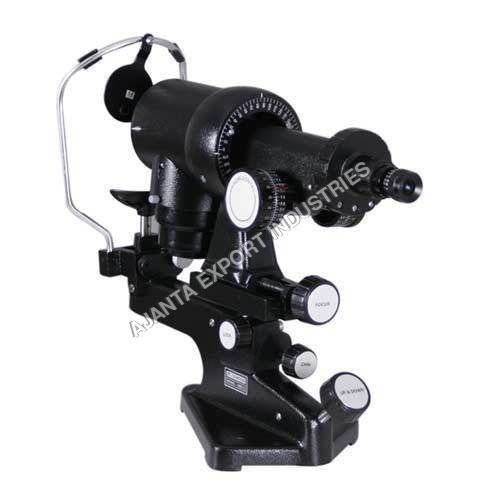
Measuring System : | External reading |
Ocular : | 15x-high-eye-point optical system |
Measuring range: | Radius of curvature 9.4 ~ 6.4mm (in o.05 mm steps) Diopter 36-52D(in 0.25D steps) |
|
Astigmatic axis: | oo180o(in 5o steps) |
Focusing distance : | 76mm |
Coincidence focusing system : | Positive measurements to .02mm accuracy |
Dimensions weight : | 16"(h) * 7"(w) * 19"(D) and weight 7 KGS |
Cutting-Edge Laser TechnologyOur Keratometer features modern laser technology, enabling ophthalmologists to obtain highly precise and repeatable corneal measurements. This advancement supports improved diagnostics, surgical planning, and enhanced patient outcomes, all within a robust stainless steel frame.
Sturdy Manual OperationWith its manual driven method, the Keratometer offers clinicians greater control during procedures. The use of stainless steel ensures durability, while the instrument's ergonomic design supports ease of handling in demanding hospital environments.
FAQ's of Keratometer Instrument:
Q: How does the Keratometer instrument measure corneal curvature?
A: The Keratometer uses laser technology to project a pattern onto the cornea and then analyzes the reflected image. By manually adjusting the device, practitioners can obtain accurate curvature measurements vital for contact lens fitting and corneal surgery.
Q: What is the primary usage of this Keratome in hospitals?
A: This Keratome is primarily used for assessing the curvature of the cornea, which is essential for diagnosing astigmatism, planning refractive surgeries, and fitting contact lenses in a clinical or hospital setting.
Q: When should a Keratometer be calibrated for optimal performance?
A: For precise results, the Keratometer should be calibrated regularly, ideally before each clinical session, or as recommended by the manufacturer to ensure continued accuracy and reliability.
Q: Where can I purchase or source this Keratometer in India?
A: As a distributor, exporter, manufacturer, supplier, and trader, we provide the Keratometer across various regions in India. Contact our sales team or visit our website to connect with authorized representatives for purchasing information.
Q: What is the process for operating this manual Keratometer?
A: To operate the manual Keratometer, the clinician aligns the instrument with the patient's eye, adjusts the position manually, and uses the laser system to take precise readings, recording the corneal curvature values for further analysis.
Q: What are the benefits of using a manual, stainless steel Keratometer?
A: A manual, stainless steel Keratometer offers the advantage of robust construction, longevity, and precise manual control, ensuring sustained performance in busy hospital environments and greater measurement accuracy.







 English
 Spanish
 French
 German
 Italian
 Chinese (Simplified)
 Japanese
 Korean
 Arabic
 Portuguese



 Send Inquiry

