Product Description
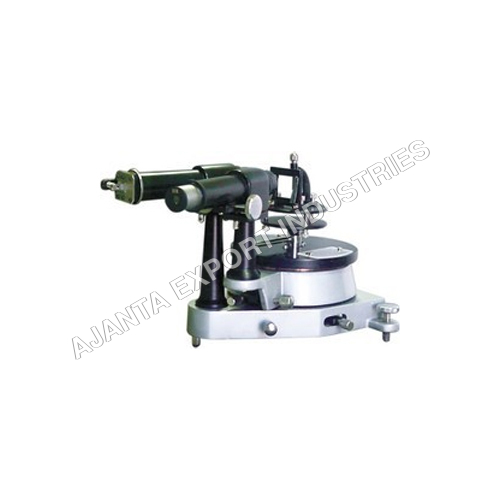
This is a robust instrument designed specifically for student use which is capable of very high performance. The main structure is of heavy cast metal, with bright plated fittings. Scale : The 150 mm. diameter circle with protective shield is fixed to the telescope movement and the table is attached to the double ended vernier which reads to 1 minute of arc. Both telescope and table rotation fine adjustment screws, and release of a clamping screws enables adjustment of both movements to be made by hand. Collimator : Mounted on fixed and fitted with 178 mm. focus achromatic objectives, 25 mm. clear aperture. Also fitted is a unilaterally adjustable slit, 7 mm. long. Telescope : Mounted on moveable pillar and fitted with 178 mm. Focus achromatic objective, 25 mm. clear aperture. Also fitted is a 8x Ramsden eyepiece and a glass crossline graticule. Both the telescope and collimator have rack and pinion focussing. Means are provided for levelling the axis of both optical units and for squaring them to axis of rotation. Prism Table : The table is marked with lines to assist placing the prism with respect to the table levelling screws.
Precision Measurement Across the Visible SpectrumEngineered for accuracy, this intermediate spectrometer enables measurement of wavelengths from 390 to 760 nm within the visible spectrum. Its vernier scale provides readings accurate to 1 minute of arc. The rotatable prism table, equipped with fine adjustment, permits precise alignment, making it highly suitable for both teaching and scientific investigation in laboratory environments.
Robust Design & Easy OperationCrafted from stainless steel and featuring a corrosion-resistant powder-coated finish, this spectrometer is built to last. Manual controls, a rack and pinion focusing mechanism, and an adjustable slit width using a micrometer screw ensure flexibility and ease of use. The stable, rectangular bench-top base with three-level adjustable screws provides a secure setup for any laboratory bench or demonstration area.
FAQ's of Intermediate Spectrometer:
Q: How does the intermediate spectrometer achieve accurate wavelength measurements?
A: The instrument uses a vernier scale, allowing readings up to 1 minute of arc, combined with precise optical alignment via a rotatable prism table with fine adjustment and manual controls, ensuring accurate results across the visible spectrum (390-760 nm).
Q: What applications is this spectrometer suitable for?
A: It is ideal for educational laboratory use, scientific demonstration, and analysis in universities, research institutes, and schools, particularly for experiments involving the measurement and study of optical spectra.
Q: Where can the intermediate spectrometer be installed?
A: This spectrometer is designed for bench-top installation in laboratory settings. Its three-level adjustable leveling screws ensure a stable and level placement on most laboratory surfaces.
Q: What are the benefits of the rack and pinion focusing mechanism?
A: The rack and pinion system allows smooth, precise focusing of the telescope, ensuring sharp imaging of spectral lines and ease of adjustment, which is essential for accurate spectral analysis.
Q: How is the slit width adjusted and why is it important?
A: The slit width is adjustable via a micrometer screw, allowing fine control over the amount of light entering the spectrometer. This adjustment is critical for optimizing resolution and ensuring accurate wavelength readings.
Q: When should I use the fine adjustment screw on the prism table?
A: The fine adjustment screw should be used during alignment of the prism or sample on the prism table to achieve optimal positioning for precise angle and wavelength measurements.
Q: What maintenance procedures are recommended for this spectrometer?
A: Regularly clean the optical components using appropriate lens cleaning methods, keep the metal housing free from dust, and check the mechanical parts for smooth operation. The durable, powder-coated finish and stainless steel build minimize corrosion and maintenance needs.







 English
 Spanish
 French
 German
 Italian
 Chinese (Simplified)
 Japanese
 Korean
 Arabic
 Portuguese



 Send Inquiry

