Product Description
INERTIA BALANCE
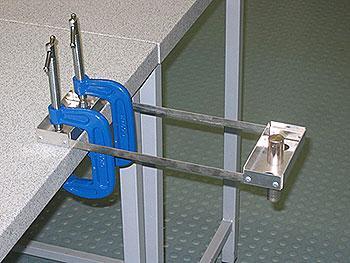
Comprising of two metal trays 130 x 55 x 23 mm are joined together with two spring steel strips of 10 mm width, the distance between the trays being 215 mm. One tray is drilled to accept 3 equal cylindrical masses. The other tray can be clamped to a bench horizontally or vertically. Complete with 3 masses and a G Clamp.Experiment with Precision and EaseWith its robust construction and easy-to-use design, the Inertia Balance is perfect for classroom demonstrations and hands-on experiments. The removable mass trays and adjustable beam allow students to quickly set up different scenarios and observe how mass influences oscillation periods, providing a clear understanding of inertia and its measurement.
Stable and Durable Laboratory EquipmentThis inertia balance features a metal base, light alloy beam, and tough plastic trays, ensuring lasting durability and stability during use. The addition of levelling feet makes it easy to achieve a stable set-up on various surfaces, guaranteeing reliable results for every experiment.
FAQ's of INERTIA BALANCE:
Q: How do I set up the Inertia Balance for an experiment?
A: To set up, place the balance on a flat surface and use the levelling feet to stabilize it. Insert the removable trays and select the required masses from the supplied set. Follow the instructions in the included manual to ensure proper assembly and operation before conducting your experiment.
Q: What kind of experiments can I perform with this Inertia Balance?
A: The apparatus is specifically designed for demonstrating and measuring inertia and mass in physics experiments. You can investigate the relationship between mass and oscillation period, or use it to compare relative inertias of different objects in a controlled, educational setting.
Q: When should I use the removable trays on the top beam?
A: The removable trays are intended for holding masses during experiments. Use them whenever you need to vary the mass being tested-they make adding, removing, or adjusting test weights straightforward and efficient for comparative studies.
Q: Where is this inertia balance typically used?
A: This equipment is most commonly found in physics laboratories at educational institutions. It is suitable for use in classrooms, teaching labs, and demonstration settings where students need to observe physical principles related to inertia and mass.
Q: What are the benefits of using levelling feet on this balance?
A: Levelling feet allow the balance to be stabilized on uneven surfaces, ensuring that your setup remains secure and your measurements accurate throughout your experiment.
Q: How accurate are the measurements taken with this product?
A: The Inertia Balance provides accuracy sufficient for educational purposes, allowing students and instructors to demonstrate key physical concepts effectively, though it may not be suitable for precision research applications.







 English
 Spanish
 French
 German
 Italian
 Chinese (Simplified)
 Japanese
 Korean
 Arabic
 Portuguese



 Send Inquiry

