Product Description
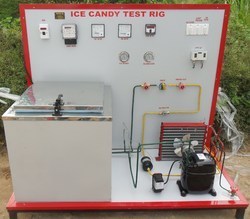
Ice Plant Test Rig is offered to the customers at highly competitive prices. These products are widely used to cater to the needs of automobile, domestic & industrial sectors, among others. Moreover, test rigs are widely used to find out ice engine's performance.
Specifications:- Compressor - Hermetically sealed 1/2 Ton capacity, for R-12 Ref. gas
- Condenser - Air cooled finned tube type with Fan & motor
- Brine Tank - Made of S. S. material, having sufficient insulation from all sides
- Ice Cans - Made of G. I. Sheet
- Thermostatic Expansion Valve
- Thermostat
- Fitter/Drier
- H.P. / L.P. cut out
- Hand Shut off Valves 2 nos
- Pressure gauges one each for high & low pressure
- Energy meter, Ammeter, Voltmeter
- Temp. Indicator with thermocouples to measure temperatures at '5' points
Versatile Refrigeration Learning ToolThe Ice Plant Test Rig offers practical, hands-on learning for students and professionals exploring refrigeration technology. Designed for laboratory use, this unit demonstrates the entire ice manufacturing process, highlighting temperature control, phase changes, and heat transfer through digital displays. Its adaptable configuration makes it valuable in technical education, industrial training, and research facilities.
Robust Construction and PortabilityCrafted with a stainless steel or GI inner chamber and a powder-coated mild steel trolley, the rig is durable and easy to maintain. Heavy-duty casters facilitate movement between laboratory spaces. The removable inner trolley and insulated hinged door provide convenient access for loading and unloading ice cans and for routine cleaning or maintenance.
Integrated Digital Monitoring and SafetyA fully integrated digital control panel gives real-time readings of temperature, pressure, and electrical parameters. The system is designed with overload relay protection and user-friendly ON/OFF controls, allowing safe operation during experiments. Accessories such as operation charts and a maintenance kit are also included for maximum utility.
FAQ's of Ice Plant Test Rig:
Q: How is ice produced using the Ice Plant Test Rig?
A: The rig uses a hermetically sealed reciprocating compressor with R134a or R404A refrigerant to chill brine in the reservoir. This cold brine circulates around immersed copper coils containing the ice cans, causing water in the cans to freeze. Uniform brine circulation ensures consistent temperature distribution and effective ice formation.
Q: What are the main applications of this Ice Plant Test Rig?
A: The primary purpose of the unit is for laboratory demonstration and educational training in refrigeration principles. It can also be used for research in process engineering, as well as for testing and evaluating refrigeration components in an academic or industrial research environment.
Q: When is manual or automatic defrosting required, and how is it performed?
A: Defrosting is required to remove ice buildup on the evaporator coils, which can occur after repeated use. The system can be configured for manual or automatic defrost cycles, depending on the model. Manual defrost is performed by pausing operation and allowing the coils to warm, while auto-defrost models initiate the cycle automatically based on temperature readings.
Q: Where should the Ice Plant Test Rig be installed for optimal performance?
A: For best results, the test rig should be placed in a well-ventilated laboratory space with access to a stable 230V AC single-phase power supply and a compressed air connection (5-6 Bar). Ensure the area allows for easy movement and access to the unit's maintenance points.
Q: What control and monitoring features does the unit provide?
A: The unit features a comprehensive digital control panel that displays temperature, pressure, and electrical parameters like current and voltage. The integrated display aids in process monitoring and helps users adjust settings for optimal ice formation. Overload and relay protections are included for added safety.
Q: How does uniform brine circulation benefit ice formation?
A: Uniform brine circulation ensures that all ice cans are exposed to consistent low temperatures throughout the process. This prevents uneven freezing, enhances heat transfer, and results in clear, evenly-formed ice blocks, which is especially important for experimental accuracy and reliability.







 English
 Spanish
 French
 German
 Italian
 Chinese (Simplified)
 Japanese
 Korean
 Arabic
 Portuguese


 Send Inquiry

