Product Description
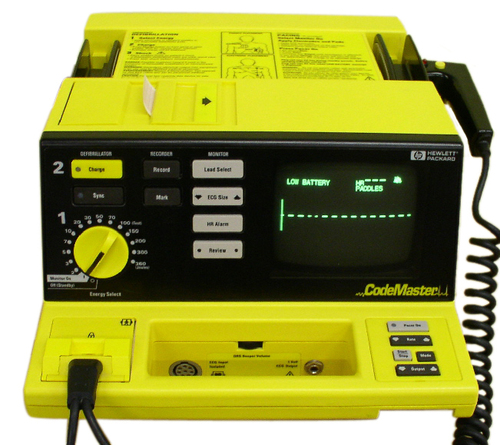
HP Codemaster Defibrillator
To fulfill the demands and needs of customers, we provide HP Codemaster Defibrillator that is available in professionally refurbished with a built-in recorder, ECG, pacing and AC power. Also, available with battery back-up, our products have several other functionalities. In addition to this, we provide customization as per the specifications laid down by the customers.
Specifications:
HP Codemaster Defibrillator are Dimensions:7.9"H x 11.8"W x 15.6"L, 20cm x 30cm x 39.7cm
HP Codemaster Defibrillator are Weight: 24 lbs. / 10.9kg
Battery:
Type: Rechargeable, sealed lead-acid battery. 4 Ah, 12 V nominal.
Charge Time: 2 hours to 90% of full capacity. 18 hours to 100% capacity. Repeated charging to less than 100% will reduce the useful life of the battery.
Capacity: 2.5 hours monitoring or 50 full-energy discharges or 1 hour monitoring and recording.
AC input: 100 to 230 VAC +/- 15%, 50/60 Hz.
Battery Indicators: Illuminated LED indicates battery is charging. Low Battery message appears on the monitor
Monitor:
Input: ECG activity may be viewed through the paddles or patient cable
Lead fault: Leads off message and dashed baseline appear on the monitor
Common mode rejection: Greater than 100dB measured as per AAMI standards for cardiac monitors
Heart rate display: Digital read out on monitor from 20 to 280 bpm
Advanced Defibrillation TechnologyThe HP Codemaster Defibrillator utilizes both biphasic and monophasic waveform technologies, which ensures effective and safe defibrillation across a range of clinical scenarios. With quick energy delivery and manual synchronization for cardioversion, it is capable of treating complex cardiac arrhythmias efficiently. Its design meets international standards for safety and performance.
User-Friendly and Portable DesignFeaturing an intuitive LCD display, clear audible and visual alarms, and easy-to-use controls, the device supports seamless operation by medical staff. Its lightweight construction (5-10 kg) and built-in handle promote portability, making it an excellent choice for both in-hospital use and mobile emergency teams. Wall-mounting options increase versatility in various care settings.
Comprehensive Monitoring and DocumentationContinuous 3-lead ECG monitoring allows for real-time assessment of cardiac rhythm, while the integrated thermal printer ensures accurate documentation of critical events. The defibrillator comes with all necessary accessories, including adult and pediatric paddles, patient cables, disposable electrodes, and a user manual, supporting consistent and reliable resuscitative care.
FAQ's of HP Codemaster Defibrillator:
Q: How do I operate the HP Codemaster Defibrillator during a cardiac emergency?
A: Begin by switching on the device, selecting the desired energy level (2-360 Joules), and applying the appropriate paddles. Use the LCD display to monitor ECG and follow on-screen prompts. For cardioversion, enable manual synchronization. The unit is equipped with both manual and AED modes, allowing trained users to select the most suitable approach.
Q: What key features make this defibrillator suitable for hospital and emergency use?
A: The HP Codemaster Defibrillator offers rapid charging, a wide energy range, manual or AED operation, intuitive alarms, and both adult and pediatric paddles. Its battery backup (up to 2 hours or 60 discharges) and portable size ensure continuous support during emergencies, while built-in ECG monitoring and event printing enhance documentation and care quality.
Q: When should the integrated thermal recorder be used?
A: The integrated thermal printer automatically or manually records critical resuscitation events, ECG rhythms, and treatment timestamps. This documentation is valuable for clinical records, quality assurance, and future case reviews.
Q: Where can the HP Codemaster Defibrillator be installed or used?
A: This device is suitable for use in hospitals, clinics, ambulances, and mobile emergency settings. With optional wall mounting and robust design, it can be placed in emergency rooms, critical care units, or other high-traffic medical areas, ensuring quick access during cardiac events.
Q: What is the process for maintaining and storing the defibrillator?
A: Store the device in a dry, cool place. Regularly inspect the battery, cables, paddles, and accessories for damage. Clean the device as per the user manual and ensure the built-in battery remains charged. Periodic functional checks and adherence to recommended guidelines keep the defibrillator ready for immediate use.
Q: How does the dual waveform technology benefit patient outcomes?
A: By providing both biphasic and monophasic waveforms, the defibrillator offers more effective energy delivery with potentially less cardiac tissue damage. This means improved success rates for defibrillation and reduced risks for patients during resuscitation or cardioversion.







 English
 Spanish
 French
 German
 Italian
 Chinese (Simplified)
 Japanese
 Korean
 Arabic
 Portuguese


 Send Inquiry

