Product Description
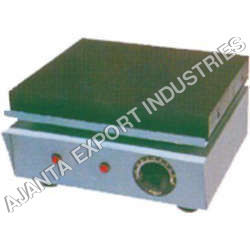
- Plates are in rectangular shape.
- Top plate over hangs by supporting M.S. pillars allows air insulation between plate and control compartment to keep control compartment cool
- Long lasting nichrom elements.
- Body made of thick mild steel /G.I sheet duly finishing in epoxy power coated shade in Regular MODEL.
- Body made of stainless - steel & plate also made of S.S in GMP MODEL.
- With energy regulator and three heat control switch.
- Max. Surface temperature :- 300c.
- Operstes on 230 volts A.C.
| CAT. NO. | SIZE OF PLATE | WATTS |
| AEI -138/ A | 10 W X16L | 1.0 K.W. |
| AEI -138/ B | 12W X18L | 2.0 K.W. |
| AEI -138 C | 18 WX24L | 3.0 K.W. |
Efficient & Safe Laboratory HeatingDesigned for accuracy and safety, this rectangular hot plate uses high-quality nichrome wire heating and an insulated asbestos sheet to deliver even, reliable heating for scientific purposes. Overheat protection and a durable powder-coated exterior ensure optimal safety and longevity, making it a dependable choice for continuous use in research labs or classrooms.
User-Friendly Operation & ControlControl temperature easily with the analog rotary knob, providing accuracy within 5C. The hot plate accommodates samples up to 5 liters and fits neatly on standard lab benches thanks to its compact rectangular shape. Plug-and-play connectivity allows rapid setup with a standard 3-pin plug, supporting a wide voltage range (220-380V).
Versatile Applications for LaboratoriesThis equipment is suitable for heating samples, chemical reactions, and other laboratory tasks. Its corrosion-resistant, easy-to-clean design and adjustable temperature make it adaptable for various research and educational applications, ensuring safe and efficient operation for years to come.
FAQ's of Hot Plate Laboratory (Rectangular) :
Q: How does the rectangular laboratory hot plate ensure safe operation during heating?
A: Safety is ensured through an asbestos sheet insulation for heat protection and an overheat protection system, reducing the risk of accidents and maintaining stable performance during prolonged use.
Q: What is the maximum temperature the hot plate can reach, and how accurate is the temperature control?
A: The hot plate can heat up to 350C, with temperature adjustments managed by a rotary knob. It provides a control accuracy within 5C, enabling precise heating for laboratory requirements.
Q: Where is this hot plate best utilized, and what are its primary applications?
A: Ideal for research laboratories and educational institutions, this hot plate is used for heating samples and conducting chemical reactions safely and efficiently.
Q: How is the hot plate powered, and what voltage supply does it require?
A: The hot plate operates on a standard electric power supply, compatible with 220-380V via a standard 3-pin plug for convenient connectivity.
Q: What materials are used in the construction of the hot plate and how do they benefit users?
A: Crafted from stainless steel, mild steel with powder coating, and a ceramic top, the hot plate offers durability, corrosion-resistance, and easy cleaning-essential for laboratory environments.
Q: What advantages does the corrosion-resistant powder-coated finish provide for laboratory users?
A: The powder-coated finish enhances the device's durability by preventing rust and surface damage, extending the equipment's lifespan even in chemically active lab environments.
Q: How can users control and monitor the heating process on this laboratory hot plate?
A: Users set the temperature with a rotary knob that offers analog display feedback, helping to maintain desired heat levels and monitor heating with accuracy.







 English
 Spanish
 French
 German
 Italian
 Chinese (Simplified)
 Japanese
 Korean
 Arabic
 Portuguese


 Send Inquiry

