Product Description
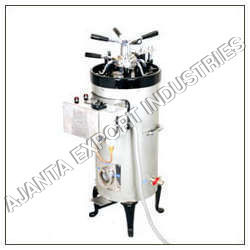
- Double drum high pressure construction
- The jacket, chamber and exterior wall made of 304 stainless steel.
- The lid consist pressure switch 2 nos. safety valve, 2 nos. steam release valve and pressure gauge.
- Microprocessor based temperature controller and DIGITAL timer
- Solid state water level controller
- Removable stainless wire mesh carrier.
| Cat. N | Chamber Inner size
| Carrier size
| Rating |
| AEI 128/ A | 12Dia x 20 Depth | 10 Dia x17 Depth | 3.0 K.W. |
| AEI -128/B | 16 Dia x 24 Depth | 14 Dia x 20 Depth | 4.0 K.W. |
Advanced Safety and PrecisionEquipped with a bolt-locked lid and safety interlock, this autoclave guarantees secure operation even at high pressures. The automatic pressure release mechanism and alarm system minimize risk, while the digital PID controller maintains temperature accuracy within 1C, ensuring optimal sterilization in each cycle.
Efficient Sterilization and Low Resource UseWith sterilization cycles adjustable between 30 and 60 minutes, the autoclave offers flexibility for various experimental needs. Its closed-cycle system conserves water, making it both efficient and environmentally responsible. The vessel's 50-liter capacity makes it suitable for large-scale laboratory and industrial operations.
Designed for Versatility and DurabilityThe high pressure autoclave is constructed from corrosion-resistant SS316 stainless steel. Its all-metal, glass-free design is ideal for high-temperature and chemically aggressive environments, making it perfect for laboratory research, industrial, and pharmaceutical applications.
FAQ's of High Pressure Autoclave:
Q: How does the safety interlock system enhance operational safety during high-pressure cycles?
A: The safety interlock ensures that the bolt-locked lid cannot be opened until the internal pressure has been safely released. This protects users from accidental exposure to pressurized or hot contents, making the autoclave exceptionally secure for laboratory and industrial applications.
Q: What is the typical sterilization process in this high pressure autoclave?
A: The sterilization cycle begins by securing materials inside the polished chamber, bolting the lid, and adjusting the cycle duration (30-60 mins) on the digital PID controller. Once the set temperature and pressure-up to 100 bar and 350C-are reached, the process maintains precise conditions for optimal sterilization before an automatic pressure release ensures safe completion.
Q: When should the sterilization cycle duration be adjusted, and for what applications?
A: Adjust the cycle duration based on the load type and sterilization requirements. Shorter sterilization times may be adequate for lightweight or sensitive materials, while denser, larger loads or critical sterilization tasks may require a full 60-minute cycle to ensure complete treatment.
Q: Where is the ideal placement for installing this high pressure autoclave?
A: Designed as a table-top unit with a thermally insulated outer body, it is best installed in laboratories, research centers, or industrial settings with level surfaces and access to a 220-240V power supply. Adequate ventilation and space for safe operation should also be provided.
Q: What are the benefits of the PTFE gasket and SS316 construction?
A: The PTFE gasket ensures a reliable chemical-resistant seal, crucial for maintaining high pressures and preventing leaks. Coupled with the corrosion-resistant SS316 stainless steel chamber, these materials extend the autoclave's lifetime and maintain sample integrity across various laboratory and industrial processes.
Q: How do you use the port connections for various applications?
A: Multiple inlet/outlet ports allow for easy introduction or removal of gases, liquids, or monitoring devices, accommodating complex experimental setups such as chemical reactions under pressure, media exchanges, or real-time sampling during high-pressure cycles.







 English
 Spanish
 French
 German
 Italian
 Chinese (Simplified)
 Japanese
 Korean
 Arabic
 Portuguese


 Send Inquiry

