Product Description
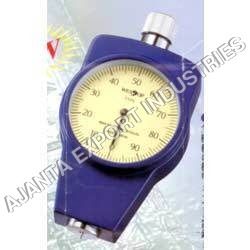
We are a preeminent manufacturer, supplier and exporter of a broad spectrum of superior quality Hardness Tester for Rubber. The range made available by us comprises of best quality in international standard with perfect design and high durability that are sourced from the most authentic vendors of the market. Offered at affordable prices, our product-line is applauded for its attractive sizes, perfect finishing and eminent durability.
Features:
Accurate and Reliable MeasurementsDelivering an impressive accuracy of 1 Shore A in the 0-100 range, this hardness tester ensures that every measurement meets global standards such as ASTM D2240 and ISO 868. The clear analog dial with a needle system and robust construction guarantee repeatable results, making it indispensable for laboratory quality checks or field inspections.
User-Friendly and Portable DesignDesigned with ergonomics in mind, the tester features a comfortable rubber grip, intuitive dial gauge, and a lightweight metal body. The carry case and user manual included make transport and operation straightforward, so users can conduct tests easily at various locations, enhancing convenience for manufacturers, suppliers, and quality control experts.
FAQ's of Hardness Tester For Rubber:
Q: How do I use the Shore A hardness tester for rubber and soft plastics?
A: To use the tester, place the device firmly against the rubber or soft plastic specimen (minimum 6 mm thick) and press until the foot is flat on the surface. Read the hardness value directly from the analog dial, which features a clear needle system for precise results.
Q: What types of materials can be tested with this device?
A: This Shore A hardness tester is suitable for measuring the hardness of rubber, soft plastics, and elastomers, making it ideal for a wide variety of industrial, laboratory, and field testing applications.
Q: When should I perform field calibration on the tester?
A: Field calibration is recommended periodically or whenever results appear inconsistent. The tester arrives pre-calibrated, but ongoing recalibration ensures continued accuracy, especially when used in different locations or by multiple operators.
Q: Where can this hardness tester be operated effectively?
A: The tester is designed for laboratory and field use, tolerating temperatures up to 50C. Its robust but lightweight construction and carrying case make it convenient for transport between testing sites or departments.
Q: What is the process for measuring hardness with this instrument?
A: First, prepare a test specimen at least 6 mm thick. Firmly press the tester's indenter onto the surface until the foot is fully in contact. The needle will indicate the hardness value on the dial. Ensure surfaces are clean for reliable readings.
Q: What benefits does the ergonomic handheld design provide?
A: The ergonomic handheld shape, rubber grip, and compact dimensions (150 x 60 x 30 mm) make the device comfortable to hold and simple to operate, promoting consistent measurement technique and ease of use during repetitive testing tasks.







 English
 Spanish
 French
 German
 Italian
 Chinese (Simplified)
 Japanese
 Korean
 Arabic
 Portuguese


 Send Inquiry

