Product Description
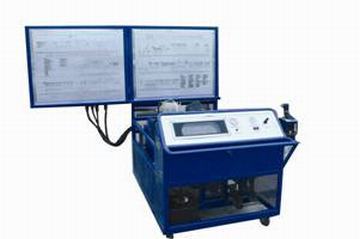
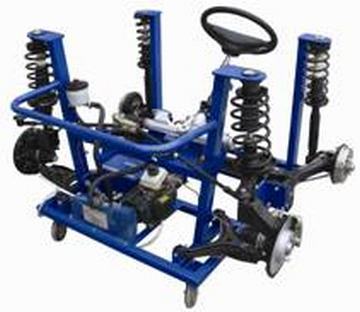
GASOLINE-ELECTRIC ENGINES TEST BED
Description:
Teaching Function:
It can completely show the structure and working principle of gasoline-electric engine to help students understand abstract theory.
It can imitate, diagnose and test the common faults and troubles of gasoline-electric engine. Train students to analyze and solve practical problems.
Extend items: Multimedia network teaching, the establishment of specialized teaching and learning environment, and standardized evaluation system.
Standard Configuration:
It can adopt the gasoline-electric engine designated by customers. The rack is divided into two parts, one the main body rack, the other test table. The main body can operate independently, and also can be used with the test table.
Extend Configuration
Test-bed and PC carry on real-time communication. The computer monitor can display work status of all sensors and actuators of electronic control system. You can set up electric circuit abruption and rosin joint of electronic control system through computers.
Configuration of multi-media network teaching and learning environment that uses a multi-board manner, each student configures information display device, the main components terminal voltage detection device and information input device, so that students learn to analyze and solve practical problems under teachers' leadership;
Standardized evaluation system, print out students' achievement lists.
Reliable Engine Testing for Education and IndustryThis test bed offers a comprehensive platform for testing gasoline engines under controlled conditions. Suitable for colleges, research institutions, and manufacturers, it includes advanced features such as an eddy current dynamometer and a water-cooled system. The design ensures accurate data collection, ease of use, and compliance with rigorous safety standards.
Advanced Measurement and Data AcquisitionEquipped with high-grade sensors and a USB interface for data logging, this system enables real-time monitoring of performance parameters including torque, speed, and fuel consumption. The large digital display and panel-mounted controls enhance usability while ensuring precise readings for analytical and educational purposes.
Integrated Safety and Flexible InstallationSafety remains paramount with emergency stop switches, overload relays, and a protective toughened glass cover. The adjustable mounting platform accommodates engines of various sizes, while lockable casters facilitate hassle-free mobility within laboratory environments or industrial workshops.
FAQ's of GASOLINE-ELECTRIC ENGINES TEST BED:
Q: How does the data logging system work on the Gasoline-Electric Engines Test Bed?
A: The test bed comes with a built-in data logging system that stores measurement data via a USB interface. Users can easily transfer information on torque, speed, power, and fuel usage for analysis or reporting, making it ideal for research and academic applications.
Q: What types of engines are compatible with this test bed?
A: The system is compatible with both 2-stroke and 4-stroke gasoline engines up to 20 HP, making it suitable for testing a wide range of small to medium-sized engines used in educational and industrial settings.
Q: When is the use of the emergency stop feature recommended?
A: The emergency stop button should be pressed whenever an unsafe condition arises during testing, such as unexpected engine behavior, system overload, or a need for immediate shutdown. This ensures both operator and equipment safety.
Q: Where can the test bed be installed?
A: The test bed is designed for laboratory and workshop environments, thanks to its lockable caster wheels and adjustable clamps, which permit flexible installation and easy relocation as per operational requirements.
Q: What is the process for setting up an engine on the test bed?
A: Setting up involves securing the engine on the adjustable clamps, connecting the engine's operational components, and using the control panel to begin measurement. The toughened glass enclosure ensures safe operation throughout the testing process.
Q: How does the eddy current dynamometer contribute to testing?
A: The eddy current dynamometer applies controlled loads to the engine, helping measure performance parameters accurately without physical contact, which improves repeatability and reliability in test results.
Q: What are the benefits of using this test bed in a laboratory or industrial setting?
A: This system provides high measurement accuracy, comprehensive safety features, and robust construction, facilitating efficient engine performance assessment, educational demonstrations, and research projects while maintaining user safety and equipment durability.







 English
 Spanish
 French
 German
 Italian
 Chinese (Simplified)
 Japanese
 Korean
 Arabic
 Portuguese


 Send Inquiry

