Product Description
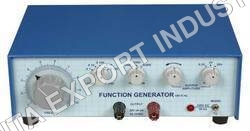
Function Generator
The Function Generator is capable of Providing SINE, SQUARE, TRIANGLE. Low Distortion Function Generator has linear Frequency Scale very low Distortion and constant signal amplitude with the output Signal Symmetry about Zero. The DC coupled output provides square wave without any appreciable Sag at low frequency. It has maximum 20 VP/P amplitude. The output is protected against short circuit. It has a offset control provided to shift the base line of signal by 10 volts. The continuously variable DC offset control further enhances the versatility of the instrument. The equipment is used in Audio Electronics and other Laboratory & Research Work. Moreover, we are looked upon as one of the major Portable Function Generator Manufacturers & Exporters in India
Versatile Signal Generation for Precision TestingThis function generator produces accurate sine, square, triangle, and TTL pulse waveforms across a broad frequency range, making it ideal for a variety of signal testing requirements. Adjustable amplitude and offset allow for precise signal tailoring, while different wave shapes support diverse testing and development scenarios in labs or repair centers.
Robust Construction and Intuitive ControlsEncased in a durable metal chassis with an ABS plastic front panel, this device is built for frequent use in demanding environments. Rotary switches and fine adjustment knobs ensure users can quickly and precisely set frequency, amplitude, and waveforms, while the analog dial scale display allows for straightforward monitoring.
Comprehensive Modulation and Attenuation OptionsEquipped with FM/AM modulation (if available) and an attenuator offering X1, X10, and X100 settings, this function generator provides extended flexibility for both basic and advanced experiments. These features help users simulate real-world conditions and protect sensitive equipment during testing.
FAQ's of Function Generator:
Q: How can I adjust the output amplitude and offset voltage on this function generator?
A: You can easily adjust the output amplitude between 2V and 20V peak-to-peak using the fine adjustment knob and rotary switches. The offset voltage is also adjustable within a 10V range, allowing you to modify the baseline level of the output waveform to suit your experimental needs.
Q: What types of waveforms are supported, and where are they commonly used?
A: The generator provides sine, square, triangle, and TTL pulse waveforms. Sine waves are typically used for testing audio or communication circuits, square and TTL pulses are ideal for digital circuit and logic testing, while triangle waves are useful for linear circuit analysis and modulation tasks.
Q: When should I utilize the built-in attenuator settings (X1, X10, X100)?
A: The attenuator settings are best used when you need to reduce the signal amplitude to protect sensitive devices or match specific testing requirements. Selecting X1, X10, or X100 will proportionally decrease the output signal, making it safer and more versatile for various circuit conditions.
Q: What is the recommended operating environment for this function generator?
A: For optimal performance and longevity, use the instrument indoors in a dust-free, non-corrosive environment. It operates efficiently in a temperature range from 0C to 50C and requires a stable 220-240V AC power supply.
Q: How does the frequency accuracy of 2% benefit laboratory applications?
A: With an accuracy of 2% of full scale, the function generator delivers reliable and consistent output frequencies, which is crucial for repeatable experiments, precise testing, and calibration in laboratory, R&D, and educational settings.
Q: What process should I follow to use the FM/AM modulation features?
A: If your model includes FM/AM modulation, you can activate these features via the control panel switches or dials. These modulation options are beneficial for simulating various transmission and receiving conditions in communication system experiments.
Q: What advantages does the analog dial scale display provide in operation?
A: The analog dial scale display gives you real-time, easy-to-read feedback on frequency and output settings. This helps in quick adjustments and monitoring during experimental procedures, enhancing workflow efficiency and accuracy.







 English
 Spanish
 French
 German
 Italian
 Chinese (Simplified)
 Japanese
 Korean
 Arabic
 Portuguese


 Send Inquiry

