Product Description
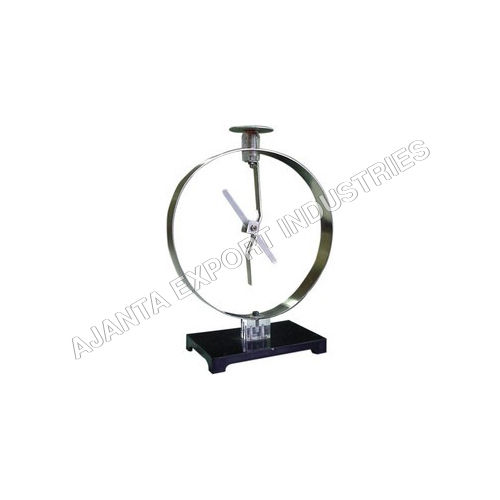
This rugged, sensitive electroscope can accept various accessories to change its capacitance. A sensitive aluminium vane is balanced in a vertical position on a metal support which is insulated from its base. The vane is easily observed and projected on a chalkboard (Light Source, not included) on which an arbitrary scale has been marked. Height without attachments is about 9". Four attachment, each equipped with a banana plug which fits the vane system top, are included : a 1" conducting sphere; a 3" conducting sphere; a proof plane with detachable insulating handle; and an aluminium cup (Faraday ice pail). Attachments can be charged using either our Electrophorus or our Power Supply (not included). With instructions.
Superior Sensitivity and ReliabilityWith gold foil leaves supported by polished brass electrodes and housed in a high-grade glass jar, this electroscope achieves remarkable sensitivity. Its ability to detect even minor static charges makes it essential in laboratories for demonstrations and experiments relating to electrostatics. The transparent jar allows easy observation, while the detachable brass cap ensures convenient sample handling.
Convenient and Durable ConstructionThe electroscope features a molded plastic base with leveling feet for stability, making it practical for any laboratory tabletop. Crafted from robust materials including brass, glass, and stainless steel, the device withstands frequent handling and provides years of reliable use. No assembly or external power is needed, streamlining laboratory setup and operation.
FAQ's of Electroscope:
Q: How does the Gold Leaf Electroscope detect electric charges?
A: The Gold Leaf Electroscope detects electric charges by utilizing gold foil leaves attached to a brass electrode. When a charged object comes in contact with or near the electrode, electrostatic repulsion causes the gold leaves to diverge, providing a visual indication of the presence and magnitude of charge.
Q: What materials is the electroscope constructed from?
A: This electroscope is built with high-quality materials, including polished brass (for electrodes), stainless steel, a transparent cylindrical glass jar (serving as insulation), and a molded plastic base. These durable materials ensure longevity and stability during demonstrations.
Q: When is this device typically used in laboratories?
A: The Gold Leaf Electroscope is commonly used during physics laboratory sessions in schools, colleges, and research facilities. It is employed for teaching and demonstrating the principles of electrostatics, detection of electric charge, and the effects of induction and conduction.
Q: Where should the electroscope be placed for optimal use?
A: Position the electroscope on a stable, level tabletop away from strong airflow or humidity. The leveling feet and molded plastic base ensure proper stability and safe operation in laboratory environments.
Q: What are the benefits of using this electroscope in educational settings?
A: This electroscope provides clear, visual observation of static electricity phenomena, making abstract concepts tangible for students. Its high sensitivity and sturdy construction foster hands-on learning and reliable experimental demonstrations in a range of laboratory activities.
Q: How do you maintain the electroscope for long-lasting use?
A: Ensure the electroscope is kept clean and dry, store it in its anti-static packaging when not in use, and handle the glass jar and gold leaves carefully to avoid damage. No complex maintenance is required due to its robust construction.
Q: What should be observed when using the electroscope?
A: Observe the angle and movement of the gold foil leaves. Leaf divergence indicates the presence of an electric charge; the degree of separation can qualitatively reflect the relative strength of the charge applied to the electrode.







 English
 Spanish
 French
 German
 Italian
 Chinese (Simplified)
 Japanese
 Korean
 Arabic
 Portuguese




 Send Inquiry

