Product Description
Educational Galvanometer
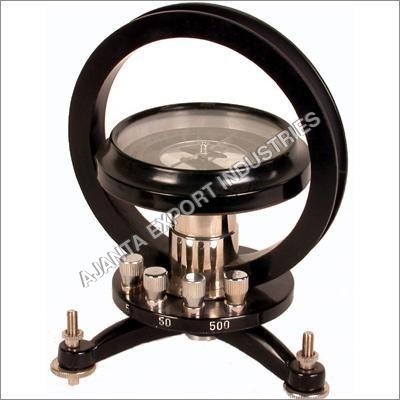
We offer high quality Tangent galvanometer. The magnetometer is supported on a brass tube fitted on an ebonite plate, which is free to revolve in the base of the instrument. The magnetometer & the ring can both be rotated independently of the base which is with levelling screws.
Key Features for Effective LearningThis galvanometer boasts high sensitivity, sturdy stability from its weighted rectangular base, and manual zero adjustment for precise calibration. The semi-circular scale with knife-edge pointer allows easy, accurate readings. Its rugged construction with stainless steel and plastic ensures durability, making it perfect for repeated use in instructional settings.
Designed for Educational DemonstrationsSuitable for both schools and higher education laboratories, this analog instrument operates solely on current from external circuits, needing no dedicated power source. It contains clear black-and-white markings for visibility, an acrylic cover for protection, and temperature resistance up to 40C, ensuring safe operation during extended laboratory sessions.
FAQ's of Educational Galvanometer:
Q: How does the moving coil permanent magnet (PMMC) mechanism in this galvanometer work?
A: The PMMC movement uses a coil suspended in a permanent magnetic field. When current flows through the coil, it interacts with the magnetic field, causing the coil-and attached pointer-to deflect proportionally, enabling precise current measurements on the calibrated scale.
Q: What is the process for calibrating the galvanometer before use?
A: Calibration is done using the manual zero adjuster knob located on the front of the device. Turn the knob gently until the pointer aligns with the zero marking on the scale. This ensures accurate readings during demonstrations or experiments.
Q: When and where is this galvanometer typically used?
A: The galvanometer is mainly used in educational settings, such as school and college physics laboratories, for teaching principles of electrical current measurement and magnetic interaction. It's also suitable for demonstration purposes in basic electrical labs and research environments.
Q: How does the internal resistance range of 20-500 ohms affect its usage?
A: The internal resistance impacts the sensitivity and measurable current range of each model. Higher resistance allows the instrument to detect smaller currents more precisely, making it suitable for experiments requiring fine measurement.
Q: What are the benefits of its manual operation and sturdy construction?
A: The manual operation eliminates the need for external power, ensuring safety and reliability. The weighted base and robust materials provide stability, while the clear acrylic cover and bold markings enhance readability and user confidence.
Q: How can users ensure accurate measurement and maintain the equipment?
A: To ensure precise measurements, calibrate the instrument before each use and avoid rough handling. Regularly clean the acrylic window and handle with care to preserve the smooth movement of the pointer and longevity of the instrument.







 English
 Spanish
 French
 German
 Italian
 Chinese (Simplified)
 Japanese
 Korean
 Arabic
 Portuguese


 Send Inquiry

