Product Description
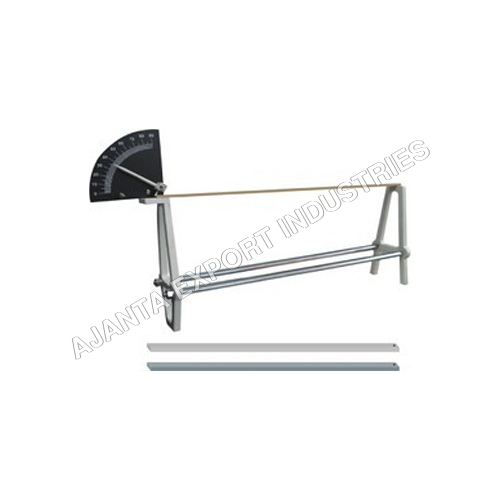
Comprising two cast-iron uprights, height 18 cm. linked by two nickel plated rods supporting on expansion bar, length 38 cm. fixed to one upright and resting on a friction pointer placed at the other. With scale reading 0 to 90 deg. With one each aluminium, brass and iron expansion bars. Precision Demonstration of Thermal ExpansionThis apparatus is engineered for physics laboratories to provide clear, hands-on demonstrations of the linear expansion of solid rods. By heating copper, iron, and brass rods within borosilicate tubes, users can observe and measure expansion using the analog scale with fine 0.1 mm graduations. The sturdy base plate and removable rods ensure convenience, while insulated handles allow safe handling during experiments.
Robust Construction and Safety FeaturesManufactured using high-quality stainless steel and borosilicate glass, the expansion apparatus promises durability and reliability. Safety is prioritized with heat-resistant handles and built-in overheat protection, making it ideal for repeated educational use. The apparatus operates efficiently with a 500W heating element and allows manual control for precise adjustment.
Versatile Laboratory ApplicationDesigned for the demonstration of solid linear expansion, this apparatus finds its use in physics classrooms, research institutions, and training centers. It provides accurate and repeatable results, making it invaluable for experimental learning, student projects, and practical assessments in the study of thermal physics.
FAQ's of Expansion Apparatus:
Q: How is the expansion measured with this apparatus?
A: Expansion is measured using an analog scale with 0.1 mm graduations. As the rod is heated by the immersion heater, its linear expansion is observed and accurately recorded on the scale.
Q: What rod materials are included, and why?
A: The apparatus comes with copper, iron, and brass rods. These materials are chosen to compare different coefficients of linear expansion, providing valuable insights during laboratory demonstrations.
Q: When should this apparatus be used in a laboratory setting?
A: This apparatus is best used during physics experiments focused on thermal expansion of solids, particularly in educational demonstrations, student practicals, or any study involving precise measurement of dimensional changes due to temperature.
Q: Where should the apparatus be mounted during an experiment?
A: The expansion apparatus should be mounted on a stable, flat laboratory surface using the sturdy base plate supplied, ensuring safety and accuracy during use.
Q: What is the typical process for conducting an experiment with this apparatus?
A: To perform an experiment, insert a rod into the glass tube, fill the flask with water (1 L approx.), heat the rod using the immersion heater, and monitor expansion on the analog scale as the temperature rises, controlled manually via the apparatus.
Q: How does the apparatus ensure user safety during experiments?
A: Safety is enhanced through heat-resistant and insulated handles to prevent burns, and overheat protection mechanisms to avoid excessive temperatures, making it suitable for classroom use.
Q: What are the benefits of using borosilicate glass and stainless steel in construction?
A: Borosilicate glass provides excellent temperature resistance and clarity for observation, while stainless steel offers strength and durability. These materials ensure longevity and precise measurement conditions in the laboratory.







 English
 Spanish
 French
 German
 Italian
 Chinese (Simplified)
 Japanese
 Korean
 Arabic
 Portuguese


 Send Inquiry

