Product Description
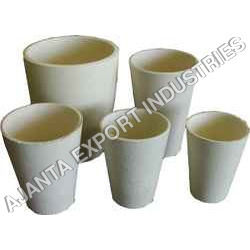
SILICA CRUCIBLES & LIDS (FUSED) REGULAR FORM SUPERIOR QUALITY THIASIL" "INFUSIL"
Capacity Crucible - Lid Crucible - Lid
15cc 90.00 90.00 110 108
25cc 100.00 100.00 135 125
50cc 200.00 140.00 265 190
80cc 340.00 270.00 490 370
100cc 430.00 330.00 - -
150cc 550.00 430.00 820 765
Optimal Material SelectionChoose from a range of high-purity materials, including alumina, silica, porcelain, or graphite, tailored for various laboratory and industrial applications. These materials ensure outstanding thermal stability, low expansion, and chemical inertness, making them ideal for high-temperature tasks.
Versatile and Customizable DesignAvailable in cylindrical, conical, or square shapes, these crucibles come in several sizes, from 10 ml up to 2000 ml. Custom dimensions can be provided to suit specific requirements, ensuring functional adaptability for diverse laboratory procedures.
Reliable Performance Under Extreme ConditionsDesigned to endure high working temperatures-up to 1700C depending on the material-these crucibles are suitable for direct flame, oven, or furnace use. Their wall thickness of 2-10 mm and thermal shock resistance promote long service life and precise analytical outcomes.
FAQ's of Crucibles:
Q: How do I select the appropriate crucible material for my laboratory process?
A: The choice of crucible material-alumina, silica, porcelain, or graphite-depends on your application and the maximum temperature required. For processes up to 1700C, high-purity alumina is recommended, while silica suits lower temperatures and chemical compatibility needs.
Q: What are the benefits of opting for a crucible with a lid?
A: A crucible with a lid helps contain volatile substances, minimizes contamination, and maintains consistent environmental conditions within the crucible, which is particularly beneficial during precise analytical or high-temperature experiments.
Q: When should a glazed versus an unglazed crucible be used?
A: Glazed crucibles are preferred for samples susceptible to contamination or when easier cleaning is required, while unglazed crucibles are ideal for applications that demand greater permeability or exposure to direct flame.
Q: Where can custom-sized crucibles be sourced?
A: Custom-sized crucibles can be ordered directly from manufacturers, exporters, or suppliers in India who specialize in laboratory equipment. Specify your dimensional requirements at the time of order to ensure the crucible fits your application.
Q: What processes are these crucibles most commonly used for?
A: These crucibles are widely employed for melting, calcining, and ashing procedures in laboratories and industries, owing to their durability, precision, and ability to withstand high temperatures.
Q: How does the wall thickness affect crucible performance?
A: A wall thickness between 2 to 10 mm provides structural strength, optimizes thermal shock resistance, and enables the crucible to withstand rapid temperature variations, promoting a longer service life.







 English
 Spanish
 French
 German
 Italian
 Chinese (Simplified)
 Japanese
 Korean
 Arabic
 Portuguese


 Send Inquiry

