Product Description
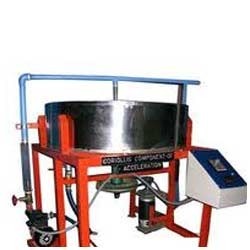
Our prominence in this domain expertise has helped us come up with Coriolis Component of Acceleration. This entire set up is designed to study various corioli's components of a slider crank mechanism. In this process the continuous stream of water which is flowing through a steady rotating pair of tubes replaces mechanical slider system. The tubes of the system can be easily rotated in various speeds with the usage of a swinging field motor which also serves a dynamometer. There is a Perspex window located on the top of the tank. This window assures complete clear view of the process. It also prevents the splashing of water over the side of the tank. The in-built dynamometer continuously measures the torque which is applied to the various rotating tubes. This entire equipment is self-contained. The re-circulating of the water is assisted with a own speed control unit and water circulating pump which is separate.
Scope Of Experimentations:
Utilities Required:
Technical Details:
Swinging field type, variable speed
Pump
FHP
The whole set-up is well designed and arranged in a good quality painted structure
Fabricated out of stainless steel
Rotating arms
9mm/6mm orifice diameter, length 300 mm
Rotameter
250 to 2500 LPH
Electric motor
Main tank
Control Panel comprises of:
Engineered specifically for laboratory environments, the stainless steel construction guarantees long-term resilience and accuracy even under rigorous use. With a temperature tolerance between 45 and 50C, it supports diverse scientific experiments and pedagogical applications, making it a dependable choice for professionals.
Energy-Efficient and Versatile OperationConsuming only 0.5 watts and functioning smoothly across a 110-220 volt voltage range, this device integrates seamlessly with standard laboratory electrical systems. Its design enables consistent performance while conserving energy, reducing operational costs.
FAQ's of Coriolis Component of Acceleration:
Q: How is the Coriolis Component of Acceleration device used in laboratory settings?
A: In laboratories, this device measures the Coriolis component of acceleration, helping researchers and students observe motion dynamics under controlled temperature and power conditions. Its design supports routine usage in educational experiments and advanced analytical studies.
Q: What advantages does stainless steel offer for this device?
A: Stainless steel provides excellent resistance to corrosion, ensures structural durability, and maintains the device's integrity even at elevated laboratory temperatures of 45 to 50C, making it ideal for long-term and repeated laboratory use.
Q: When should you consider using this device in your experiments?
A: This device is particularly beneficial when experiments require accurate analysis of motion and acceleration in environments ranging from 45 to 50C. It is suitable for educational demonstrations as well as specialized research requiring precise measurement of Coriolis effects.
Q: Where can the Coriolis Component of Acceleration device be sourced in India?
A: You can acquire this device from reputed distributors, exporters, manufacturers, suppliers, and traders throughout India, who specialize in advanced laboratory equipment.
Q: What is the process for setting up and operating the device?
A: Installation is straightforward: connect the device to a standard 110-220 volt power supply, ensure the ambient laboratory temperature is within 45 to 50C, and follow the operational guidelines provided by the manufacturer for accurate results.
Q: What are the benefits of using this device in a laboratory environment?
A: The device offers reliable performance, minimal energy consumption, and robust construction. It helps improve experimental accuracy, enhances teaching demonstrations, and supports research on the physics of rotational dynamics.







 English
 Spanish
 French
 German
 Italian
 Chinese (Simplified)
 Japanese
 Korean
 Arabic
 Portuguese


 Send Inquiry

