Product Description
Salient Features
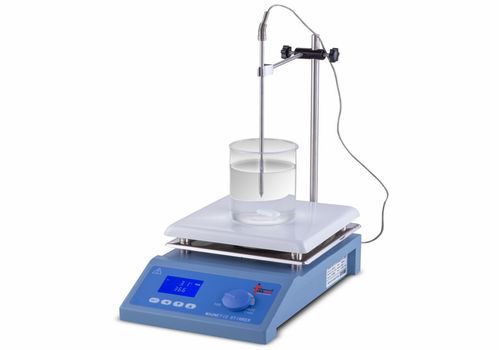
| | Digital LCD display with back light |
| | Big Size Ceramic hot plate with flame protection and durability |
| | Heating and stirring can proceed simultaneously. |
| | Temperature & Stirring speed is stepless adjusted. |
| | Real temperature & speed display on the screen simultaneously |
| | Two sensors, outside PT 100 sensor controls the liquid temperature, inside K type sensor control the hot plate temperature (selectable) |
| | Over temperature alarm |
| | Connect the temperature probe and place into glass container being stirred to measure and maintain the object temperature. Accuracy is ±1 °C. |
| | STANDARD ACCESSORIES |
| | Stir Bar, Temperature Probe, Stand, Instruction Manual
| Make | LABMAN | | Display | Digital | | Speed(RPM) | 100-1600 | | Plate Size(mm) | 190 x 190 | | Top Plate Size | Ceramic | | Max. Volume (ml) | 5000 | | Temp. Controller | PID | | Max Temp. ( Plate Surface) | 300°C | | Temp.resolution | 0.1°C | | Temp. Accuracy | 0.5°C | | Power Wattage | 600 W | | Power supply | AC 220V / 50Hz | | Dimension LxWxH (mm) | 300 x 190 x 126 | | Weight | 5 kg | |
Efficient Laboratory Mixing and HeatingDesigned for rigorous laboratory tasks, this magnetic stirrer combines strong stirring capability with rapid, uniform heating. Its ceramic coated platform delivers quick heat-up times and resists chemical corrosion, making it suitable for a range of solutions and glassware types.
Precision and Safety in Every ExperimentFeaturing analog control knobs, users achieve accurate temperature (1C) and speed (10 RPM) adjustments. Overheating protection and non-slip feet ensure stable, secure operation, even during continuous laboratory workflows.
Built to Last in Demanding EnvironmentsA chemical-resistant body, sturdy construction, and easy-to-clean surfaces guarantee durability and extended service life. The 5-liter capacity and compatibility with borosilicate glassware support both routine and intensive research applications.
FAQ's of Ceramic Hotplate Magnetic Stirrer:
Q: How do you operate the Ceramic Hotplate Magnetic Stirrer for optimal mixing and heating?
A: To operate the stirrer, place your borosilicate glassware containing the solution on the center of the ceramic plate, insert the included stir bar, and use the analog control knobs to set the desired stirring speed (100-1500 RPM) and temperature (up to 380C). The device is rated for continuous duty, making it suitable for extended laboratory experiments.
Q: What benefits does the ceramic coated plate provide?
A: The ceramic coated plate offers superior chemical resistance, fast and even heating, and is easy to clean. This makes it ideal for handling a wide range of chemical solutions, ensuring longevity and consistent performance in laboratory settings.
Q: When should I use the overheating protection feature?
A: The built-in overheating protection is automatic and engages whenever the unit detects unsafe temperature levels, ensuring sample integrity and user safety during prolonged or high-temperature experiments.
Q: Where can this magnetic stirrer be used most effectively?
A: This stirrer is intended for laboratory settings such as research institutes, schools, and industrial labs. It performs best in controlled environments with ambient temperatures ranging from 5C to 40C, particularly where reliable, repeatable mixing and heating are essential.
Q: What types of glassware are suitable for use with this stirrer?
A: The hotplate magnetic stirrer is specifically designed for compatibility with borosilicate glassware, making it ideal for beakers, flasks, or other standard lab containers that can withstand rapid temperature changes.
Q: How do you maintain and clean the magnetic stirrer?
A: Ensure the unit is unplugged and cooled before cleaning. Simply wipe the ceramic plate and body with a damp cloth and mild detergent. The chemical-resistant materials make it easy to maintain, and regular cleaning helps extend service life.
Q: What are the primary advantages of using this stirrer in a laboratory?
A: Key advantages include efficient, homogeneous solution mixing, precise temperature and speed control, chemical resistance, and safety features. These qualities reduce manual effort, enhance experimental reliability, and make routine lab procedures more efficient.







 English
 Spanish
 French
 German
 Italian
 Chinese (Simplified)
 Japanese
 Korean
 Arabic
 Portuguese


 Send Inquiry

