Product Description
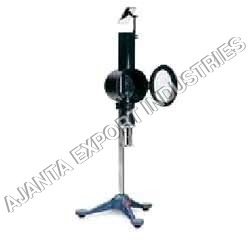
Product Details:Smoke Point Apparatus determines the smoke point of kerosene and aviation turbine fuel by measuring the maximum flame height prior to smoke formation and comparing the results with those of known standards.
- Tripod stand, lamp body and chimney
- Viewing window
- Robust construction
- Calibration and verification equipment available
Benefits:
The smoke point gives an indication of aromatic content and radiant heat transfer characteristics and has good correlation with ASTM D1740 (Lumino meter number).Comprises a tripod stand, lamp body, and chimney. The measuring scale is viewed through a curved glass window on the front of the instrument. A mirror (10450-0) can be attached to the chimney to aid smoke detection. Supplied with candle assembly and certified wick.
Methods:
- ASTM D1322: Standard test method for smoke point of kerosene and aviation turbine fuel
- IP 57 - Petroleum products: Determination of the smoke point of kerosene
- BS 2000 Part 57: Petroleum products. Determination of the smoke point of kerosene
- ISO 3014: Smoke Point
- NF M07-028: Smoke Point
Specifications:
Part Number: | 10400-0 |
CCCN Code | Tariff 90271090 |
Size (H × W × D) | 47 cm × 21 cm × 19 cm |
Weight | 2.6 kg |
Engineered to meet ASTM D1322 standards, this smoke point apparatus assures consistent, accurate results during fuel analysis. Its precision scale and standardized dimensions guarantee reliable measurement with 1 smoke point unit accuracy, making it indispensable for quality control labs.
Designed for Safe and Simple OperationFeaturing heat-resistant handles and a stable base, the apparatus prioritizes user safety. Simple hand adjustment for manual operation and a user-friendly design offer a streamlined, controlled testing environment without the need for specialized training.
Portable, Durable, and Easy to MaintainWeighing between 2.6-5 kg, its portable form factor allows convenient movement within laboratories. Robust corrosion-resistant materials and optionally powered operation ensure longevity, while easily removable components make cleaning efficient and straightforward.
FAQ's of Smoke Point Apparatus:
Q: How does the Smoke Point Apparatus ensure accurate measurement of smoke points?
A: The apparatus is equipped with a precision graduated scale that allows users to observe and record smoke points accurately within 1 unit. Its chimney and sample cup dimensions conform to ASTM D1322, ensuring standardized results.
Q: What types of fuels can be tested with this apparatus?
A: This apparatus is specifically designed for testing the smoke point of kerosene and aviation turbine fuels, commonly used in laboratory quality assessments and fuel certification processes.
Q: When should the manual or electric heating variant be used?
A: The manual variant is ideal when electricity access is limited or not desired, while the electric heating version (220V) is preferred for consistent temperature control or in high-throughput laboratories.
Q: Where is the apparatus commonly used?
A: It is widely used in laboratory facilities across oil refineries, fuel research institutions, academic centers, and quality testing labs, particularly in India and internationally.
Q: What are the main safety features incorporated in the apparatus?
A: The device includes heat-resistant handles and a stable base plate, both of which minimize the risk of burns and tip-overs during operation, enhancing user safety in busy laboratory environments.
Q: What is the process for determining the smoke point using this apparatus?
A: A measured sample is placed in the brass cup beneath the specially designed burner, then heated either manually or electrically. Observers adjust the flame and note the smoke point through the borosilicate glass chimney using the marked scale.
Q: What benefits does its portable and corrosion-resistant design provide?
A: Portability enables easy relocation within the lab, while corrosion-resistant materials like brass and stainless steel ensure reliable, durable performance with minimal maintenance, extending equipment longevity.







 English
 Spanish
 French
 German
 Italian
 Chinese (Simplified)
 Japanese
 Korean
 Arabic
 Portuguese


 Send Inquiry

