Product Description
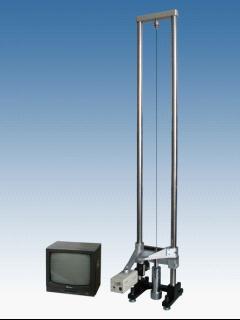
CCD ELONGATION METHOD YOUNGG'S MODULUS MEASURING APPARATUS
Description:
Demonstration of deformation of a wire under load, which is parallel to the axis of the wire and is applied to one end while the opposite end is held fixed. A microscope and CCD image-forming system is equipped to clearly display the result and you can observe in an easy way.
Details:
| Height of column | 1.32m (stainless steel tube) |
| Length of metal wire | 95cm |
| Sample | steel wire |
| Reading microscope | range 0~8mm, resolution 0.01mm |
| Weight | 50.0g 10 pieces, balance weight 200.0g |
| CCD and monitor | 300 thousand pixels CCD, 14 inch monitor |
Precision and Non-Contact MeasurementEmploying a charge coupled device (CCD) sensor with a 640 x 480 pixel resolution, this apparatus enables non-contact and high-precision elongation measurements with an accuracy of 0.01 mm. This advanced technology ensures reliable and repeatable results when testing various materials like supplied steel and copper wires.
Robust Build and Laboratory VersatilityConstructed from stainless steel, aluminum, high-grade acrylic, and optical-grade glass, the apparatus resists environmental and accidental damage. Its bench-top rectangular design offers easy installation and portability, making it perfect for physics laboratories, research institutions, and academic demonstrations alike.
User-Friendly Data Interface and AccessoriesA digital USB output enables swift connection to PCs for data recording and analysis. The included accessories-sample wires, weights, hanger, and instruction manual-facilitate immediate operation. Clear digital displays and manual/knob controls make it accessible for users at all experience levels.
FAQ's of CCD ELONGATION METHOD YOUNGG'S MODULUS MEASURING APPARATUS:
Q: How does the CCD Elongation Method Young's Modulus Measuring Apparatus function?
A: This apparatus measures the elongation of supplied sample wires-steel and copper-when subjected to a load, using a high-precision CCD sensor. The sensor captures displacement in the wire without direct contact, and the data is displayed digitally and can be exported to a PC for analysis.
Q: What types of samples can be used with this equipment?
A: The device is optimized for steel and copper wires, which come supplied with the apparatus. However, it can accommodate other similar metallic wires suitable for Young's modulus experiments within the documented measurement and load ranges.
Q: When is calibration necessary, and is it included?
A: Calibration is provided with the system prior to delivery, ensuring accuracy from the first use. Additional calibration may be performed as per the guidance in the instruction manual if measurement precision appears compromised over time.
Q: Where can this Young's Modulus Measuring Apparatus be used?
A: It is designed for use in academic, research, and laboratory environments, particularly physics labs in schools, colleges, and universities. Its rugged yet portable build allows placement on any stable bench-top surface.
Q: What is the process for measuring elongation with this product?
A: After securing the sample wire and adjusting the load (up to 2 kg), the CCD sensor detects elongation as force is applied. The resulting digital output provides displacement data in real time, which users can analyze directly or export to a connected PC.
Q: How does this apparatus benefit laboratory instruction or demonstration?
A: By providing non-contact, high-precision, and real-time measurement, students and researchers can perform experiments efficiently and accurately, deepening understanding of material properties and experimental physics principles.
Q: What advantages does the digital USB data output offer?
A: The digital USB output allows direct connection of the apparatus to a PC, making it easy to record, analyze, and archive experimental measurements, thus streamlining laboratory workflow and facilitating detailed reporting.






 English
 Spanish
 French
 German
 Italian
 Chinese (Simplified)
 Japanese
 Korean
 Arabic
 Portuguese


 Send Inquiry

