Product Description
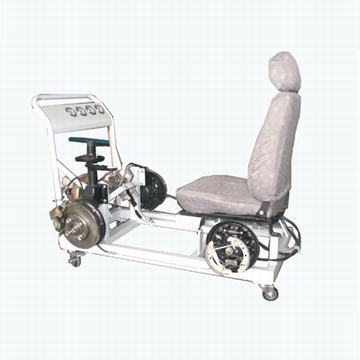
BRAKE ASSEMBLY & STRUCTURE EDUCATIONAL SYSTEM
Description:
The structure of the automobile hydraulic brake system can be directly observed to make the students understand the construction and the operating principle of the system. It is made up of the good-quality spare parts of the vehicle and can be operated normally .Pressure gauge shows the operating process of the brake system. The whole frame of the training model is made of GB steel with surface sand blasted. Key area is highlighted by the lights.Details: Net Weight : | 340Kg |
Gross Weight: | 360Kg |
Package Size: | 2000*1500*1300 |
CONFIGURATIONS: |
Frame | 1 |
Operating Instruction | 1 |
Comprehensive Educational ToolThis system provides a detailed, real-world approach for teaching the fundamentals of automotive brake assemblies. By enabling hands-on engagement with both disc and drum brake systems, as well as providing sectional views and labeled parts, students gain a strong conceptual foundation tailored for mechanical engineering and technical training.
Durable and Portable DesignBuilt with a mild steel frame, ABS plastic components, and a transparent acrylic panel, the system combines durability with practical mobility. Lockable wheels ensure ease of transport and stability during use, while the anti-rust, powder-coated finish extends equipment longevity in varied academic environments.
Safe and User-Friendly OperationSafety is prioritized with rounded edges, a non-slip base, and a manual control system requiring no external power. The model delivers a straightforward, assembly-free setup, making it accessible and ready for immediate educational use. The transparent display panel also ensures safe, unhindered observation of brake mechanisms in action.
FAQ's of BRAKE ASSEMBLY & STRUCTURE EDUCATIONAL SYSTEM:
Q: How is the Brake Assembly & Structure Educational System used for teaching?
A: The system is utilized by educators and learners to practically demonstrate and explore the structures and operations of disc and drum brake assemblies, with clearly labeled components, sectional views, and diagrams enhancing conceptual understanding during hands-on exercises.
Q: What are the main benefits of this system for technical institutes and engineering colleges?
A: Its key advantages include realistic demonstrations of braking systems, immediate readiness without assembly, high durability, and improved student engagement through transparent observation panels and moveable, robust construction.
Q: Where can this educational system be placed or installed?
A: The system is adaptable for both tabletop and floor-standing setups, making it versatile for use in classrooms, laboratories, and workshops within technical institutes, polytechnics, and engineering colleges.
Q: When is the best time to integrate this equipment into training programs?
A: It is ideal for use during introductory modules on automotive engineering, brake systems, or mechanical fundamentals, as well as for practical sessions that require visual and experiential learning aids.
Q: What safety features are incorporated into the system's design?
A: Safety is emphasized through rounded edges on all exposed parts, a non-slip base to prevent movement during use, and a display panel that resists temperatures up to 60C, ensuring secure handling during demonstrations.
Q: How is the demonstration conducted without a power source?
A: All component movements and brake operations are performed via manual levers and pedals, allowing students to physically engage with the system and observe results immediately without reliance on electricity.
Q: What is the process for maintaining or cleaning the system?
A: Thanks to its powder-coated, anti-rust frame and accessible design, the system requires minimal maintenance-simply wipe with a non-abrasive cloth and avoid using harsh chemicals to keep the acrylic panels clear and components in optimal condition.







 English
 Spanish
 French
 German
 Italian
 Chinese (Simplified)
 Japanese
 Korean
 Arabic
 Portuguese


 Send Inquiry

