Product Description
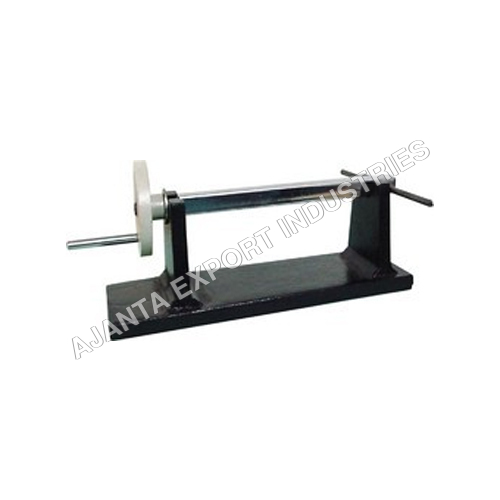
To show the forces which can be exerted during thermal expansion or contraction. Comprising a heavy cast iron frame 340x120x100mm with slotted end pillars to carry a stout iron bar. The bar is threaded at one end for a large tensioning nut and has holes at the other end to accommodate the cast iron breaking bars. Supplied complete with ten breaking bars Durable and Precise ConstructionConstructed with a rigid mild steel frame and a powder-coated or painted finish, the Bar Breaking Apparatus ensures longevity and repeated use in classroom environments. The stable, non-slip base and secured clamps enhance safety and experimental reliability, making it ideal for rigorous educational settings.
Effortless Operation and DemonstrationOperating the apparatus is straightforward-place the test bar in the secured clamps, apply force using the adjustable lever arm, and observe the breaking point using the analog display. The process clearly demonstrates material strength principles, allowing students to witness live examples of physics theory in action.
FAQ's of Bar Breaking Apparatus:
Q: How is the Bar Breaking Apparatus used in a laboratory setting?
A: Simply mount the apparatus on a bench or table, insert a test bar into the secured clamps, and use the adjustable lever arm to apply force until the bar breaks. Observations can be made via the analog/dial display for clear demonstrations of material strength.
Q: What makes this apparatus suitable for educational purposes?
A: Its manual operation, adjustable settings, clear display, and replaceable test bars allow for multiple, varied experiments. It visually demonstrates physical concepts such as bending and breaking strength, which are vital for physics and engineering lessons.
Q: When should the optional weights be used during a demonstration?
A: Optional weights can be used when a constant or additional load is needed to vary the force applied by the lever. This allows more precise control and a wider range of experimental conditions, making demonstrations more comprehensive.
Q: Where can the Bar Breaking Apparatus be installed?
A: The apparatus is designed for bench or table-top mounting, making it adaptable to most laboratory setups. Its compact, rectangular base (approx. 65 x 25 x 25 cm) ensures it fits into standard classroom environments.
Q: What materials can be tested with this apparatus?
A: Primarily, round aluminium or steel bars up to 10 mm in diameter and 40 cm in length are used. The replaceable test bars accommodate different material properties for comparative experimentation.
Q: How does the safety mechanism of the apparatus function?
A: The Bar Breaking Apparatus includes secured clamps to firmly hold the test bars, and a non-slip base to prevent movement during testing, ensuring safe operation for students and instructors alike.
Q: What are the key benefits of using this apparatus for students?
A: Students gain hands-on experience with mechanical testing, better comprehension of material properties, and the opportunity to engage with live demonstrations of theoretical concepts, enhancing both practical skills and theoretical understanding.







 English
 Spanish
 French
 German
 Italian
 Chinese (Simplified)
 Japanese
 Korean
 Arabic
 Portuguese


 Send Inquiry

