Product Description
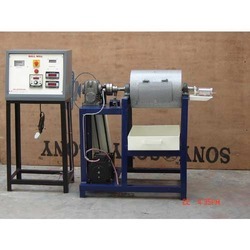
We offer a wide array of Ball Mills. The ball mills offered by us are manufactured using superior quality raw material and advanced technology, which ensure easy and safe operation, stable performance and longer functional life. They have a cylindrical shape and flat bottoms reinforced with a row of ribs. the offered range of ball mills is best suited for wet as well as dry grinding and mixing. Moreover, we provide our range in various specifications to our clients as per their requirement.Features:- Different sizes
- Provide pure metal
- Easy operating system
Efficient Grinding PerformanceDesigned for laboratory use and pilot-scale operations, our ball mills provide uniform and efficient grinding. Powered by a reliable foot-mounted induction motor, the system ensures consistent rotational speeds between 20 and 35 RPM. The drive system, available in gear/chain or V-belt variants, enhances reliability and longevity during extended operation cycles.
Adaptable Construction MaterialsAvailable in both Mild Steel and premium Stainless Steel (304/316), these ball mills can be customized with your choice of chamber lining-whether rubber, ceramic, or steel. Versatile grinding media options (ceramic or stainless steel balls) support a wide spectrum of material processing needs for scientists, exporters, and manufacturers alike.
Customizable Features for Diverse ApplicationsChoose from manual or automatic discharge, various chamber sizes (500L to 5000L), and customizable outer dimensions. Optional extras such as insulation and digital recording for RPM and time are available. The devices maintain a noise level below 85 dB and can be configured for ambient to 80C working temperatures, ensuring safety and operational efficiency.
FAQ's of Ball Mills:
Q: How do I select the right material of construction for my ball mill?
A: The choice between Mild Steel and Stainless Steel 304/316 depends on your application's requirements, such as chemical compatibility and corrosion resistance. Stainless steels are preferable for corrosive environments or applications involving food and pharmaceuticals, while Mild Steel suits general-purpose uses.
Q: What types of grinding media can be used in these ball mills?
A: You may use either ceramic balls or stainless steel balls, depending on your material and required abrasion resistance. Ceramic media are often chosen for processing non-metallic or sensitive materials, while stainless media suits robust, metallic, or more abrasive applications.
Q: When should I opt for manual versus automatic discharge?
A: Manual discharge is suitable for small batches or when operator control is desired. Automatic discharge enhances efficiency and is ideal for larger-scale or repetitive batch processes, minimizing operator involvement and reducing downtime.
Q: Where can these ball mills be installed, and are they suitable for laboratory use?
A: These ball mills are specifically designed for both laboratory and pilot-scale use. Their customizable size, manageable weight, and controlled noise level make them ideal for installing in research laboratories or small to medium manufacturing setups across India and abroad.
Q: How is temperature managed during the milling process?
A: The ball mills are engineered to operate within ambient to 80C for wet milling applications. Optional insulation is available to minimize heat loss, and uniform heat distribution is ensured by the rotational mechanism, supporting precise processing conditions.
Q: What are the main benefits of using your ball mills for laboratory applications?
A: Benefits include customizable construction, low noise (<85 dB), optional digital monitoring, energy-efficient power consumption (2-20 HP), and safe operation. The adaptable design accommodates a wide range of capacities and can be tailored to the specific requirements of scientists, exporters, and manufacturers.







 English
 Spanish
 French
 German
 Italian
 Chinese (Simplified)
 Japanese
 Korean
 Arabic
 Portuguese


 Send Inquiry

