Product Description
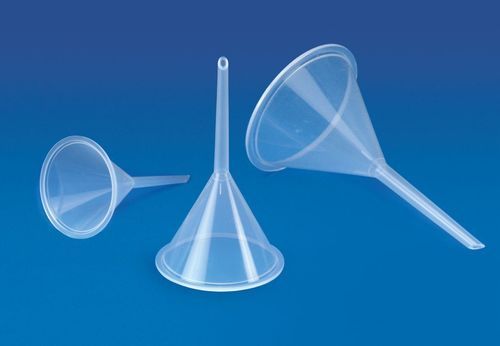
ANALYTICAL FUNNEL
Designed specifically for analytical chemistry, the body of the funnels is 0 60 . Moulded in PP, these funnels are provided with internal & external ribs to prevent air blockage.Material : Polypropylene
| PARTICULARS | INSIDE | STEM LENGTH | PACKING |
|---|
| 35 mm. | 35 | 37 | 72 Pcs. |
| 50 mm. | 50 | 50 | 72 Pcs. |
| 62 mm. | 62 | 67 | 36 Pcs. |
| 75 mm. | 75 | 77 | 36 Pcs. |
| 100 mm. | 100 | 95 | 36 Pcs. |
Engineered for Accuracy and DurabilityOur Analytical Funnels are crafted from high-quality borosilicate glass or chemical-resistant plastic, ensuring longevity and repeatability in laboratory settings. Their smooth, non-porous surface allows for easy cleaning and prevents sample retention, enhancing accuracy during filtration and analysis.
Chemical Resistance with Versatility in ApplicationThese funnels offer outstanding resistance to a range of acids and alkalis, making them suitable for diverse chemical laboratory tasks. Whether used for filtration, separation, or sample preparation, their leak-proof, conical design delivers reliable results across various analytical procedures.
Safe, Easy Maintenance and Flexible PackagingThe autoclavable property enables safe sterilization, while the reusable material cuts down on replacement costs. Choose between individual or bulk packaging, adapted to your laboratory's specific requirements, with dimensions and capacities that cater to a wide range of experimental needs.
FAQ's of ANALYTICAL FUNNEL:
Q: How should the analytical funnel be used for laboratory filtration?
A: To use the analytical funnel, place a filter paper inside the conical section and securely position the funnel in a compatible flask or container. Slowly pour your sample solution through the funnel, allowing gravity-driven filtration while ensuring no spillage or overflow. The smooth, non-porous surface promotes efficient liquid flow.
Q: What materials are available for this funnel, and how does that affect performance?
A: The funnel is offered in borosilicate glass and chemical-resistant plastic. Both materials provide high chemical resistance, with borosilicate glass excelling in temperature stability (up to 250C) and resistance to acids and alkalis, making them reliable for most analytical tasks.
Q: When is it necessary to autoclave the analytical funnel, and how often can it be reused?
A: Autoclaving is recommended after each use in procedures involving hazardous or sensitive materials to ensure sterilization. Due to its robust construction and high-quality materials, the funnel withstands repeated autoclaving without compromising integrity, allowing for numerous reuses.
Q: Where can these analytical funnels be sourced and what packaging options are available?
A: The funnels are available through distributors, exporters, manufacturers, suppliers, and traders across India. Customers can select between individually packed units or bulk packaging depending on their laboratory requirements.
Q: What is the process to clean and maintain the funnel for repeated use?
A: Rinse the funnel with a suitable solvent immediately after use, followed by cleaning with laboratory detergent and water. For thorough sterilization, autoclave the funnel according to standard protocol. The smooth, non-porous surface ensures that residues are easily removed, maintaining high operational accuracy.
Q: What are the benefits of choosing this analytical funnel for laboratory applications?
A: These funnels offer outstanding chemical resistance, precision, leak-proof filtration, and adaptability for various laboratory procedures. Their durable, autoclavable, and reusable design makes them cost-effective and reliable for long-term analytical and filtration tasks.







 English
 Spanish
 French
 German
 Italian
 Chinese (Simplified)
 Japanese
 Korean
 Arabic
 Portuguese


 Send Inquiry

