Product Description
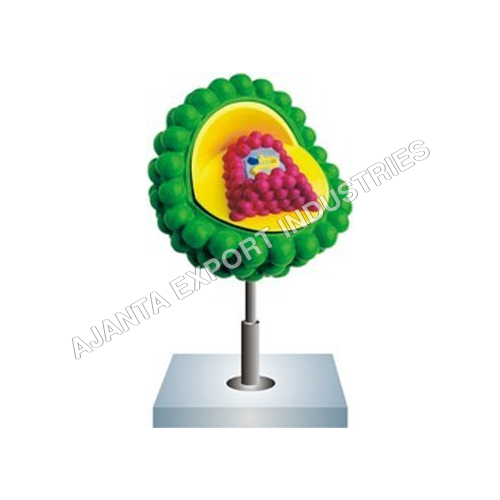
HIV virus
Model of HIV virus is enlarged millions of times shows the outer lipid membrane with protein structures. and the internal nucleus which contains the viral hereditary matter (RNA). The nucleus is removable and condoms can be put unerneath to provide a message regarding measures to take in protecting against HIV infections. Size overall 180x130x130 mm. approx.
Detailed and Durable ConstructionMade from durable PVC material, the model ensures longevity even with frequent handling. The precision in its design allows for accurate demonstration of the Aids Virus structure, making it a valuable asset for teaching environments and laboratory settings.
Educational Use and Practical ApplicationsThis model is tailored specifically for classroom instruction, science fairs, and laboratory education. Its dimensions and clarity make it suitable for individual or group study, allowing learners to engage in hands-on exploration of virus anatomy.
FAQ's of Aids Virus:
Q: How can the PVC Aids Virus model be used in school projects?
A: The model can be used as a visual aid in school presentations and science fairs, helping students demonstrate their knowledge about the structure and function of the Aids Virus, thereby enriching their learning experience.
Q: What are the benefits of using this Aids Virus model in a biological laboratory?
A: It provides clear, tangible representation of the Aids Virus, making it easier for students and researchers to understand complex viral components, processes, and interactions during lessons or experiments.
Q: When is the appropriate time to utilize this virus model in an educational setting?
A: The model is ideal for use during virology lessons, biology classes, laboratory demonstrations, or while preparing for academic competitions and projects focused on viruses and human health.
Q: Where can this Aids Virus model be purchased?
A: The model is available through distributors, exporters, manufacturers, suppliers, and traders, ensuring accessibility for educational institutions, laboratories, and individual learners.
Q: What is the process for demonstrating the Aids Virus structure using this model?
A: To demonstrate, presenters can use the model to point out key viral parts and explain their roles, making lessons more interactive and helping students visualize microscopic details that are otherwise hard to grasp.
Q: What advantages does the PVC material provide for this educational model?
A: PVC makes the model lightweight yet robust, enabling repeated use in classrooms and labs without damage. It also allows for detailed manufacturing, improving the accuracy of anatomical features.







 English
 Spanish
 French
 German
 Italian
 Chinese (Simplified)
 Japanese
 Korean
 Arabic
 Portuguese





 Send Inquiry

