Product Description
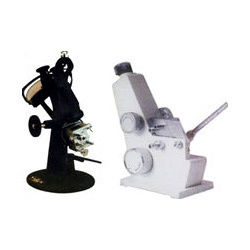
Abbe Refractometer
We offer a wide range of superior quality Abbe Refractometer. The offered instrument is widely used in laboratories to measure the index of refraction. Imported from leading vendors across the globe, these work in relation with Snell's law and the calculation is done by analyzing the composition of the material by Gladstone-Dale equation. These can accurately measure the refractive index between nD 1.3000 to 1.7000 with sugar percentage (Brix) of 0-95%.
The models available with us are as follows:
- Abbe Refractometer NAR-1T Atago Japan with built in light fourth place by estimation, 5-50C Temp
- Abbe Refractometer RL-3 Poland make
- Abbe Refractometer 2 WAJ Taiwan make (Imported)
- Abbe Refractometer Rajdhani model No. RSR - 1 Indian make
- Abbe Refractometer advance model R-4 Indian make
- Abbe Refractometer GNI or other Indian make models with warranty
- Digital Abbe Refractometer Atago, Japan make, model DR A-1
- Digital Abbe Refractometer WAY 2S, Taiwan make
- Refractometer for Oil & Sugar (Butyroo Refractometer)
Precision Meets DurabilityCrafted from high-quality stainless steel with a resilient, corrosion-resistant optical glass prism, this Abbe Refractometer offers both precision and long-lasting durability. Its robust construction withstands frequent laboratory use while maintaining reliable accuracy and effortless cleaning, making it an indispensable analytical tool.
Accurate Measurement with Built-in Temperature ControlTemperature fluctuations can affect refractive index measurement. This instrument features a built-in water circulation system and thermometer attachment, allowing precise temperature stabilization up to 75C. Users can further enhance temperature control with an optional water-bath, ensuring consistently accurate results in every session.
Simple and Efficient OperationWith manual vernier adjustment and an analog graduated scale, users can achieve high-resolution readings (to 0.0001 nD) with ease. The design accommodates quick sample loading and uses only a few drops (approx. 0.5 mL), streamlining the measurement process for liquids, solids, and solutions in laboratory settings.
FAQ's of Abbe Refractometer:
Q: How do I use the Abbe Refractometer to measure refractive index or Brix value?
A: To measure, place a few drops (about 0.5 mL) of your sample onto the freshly cleaned optical glass prism, close the prism, and use the manual vernier adjustment to align the view. Read the refractive index or Brix value directly from the analog graduated scale.
Q: What is the process for temperature stabilization during measurements?
A: Temperature stabilization is achieved by circulating water through the built-in system, maintaining sample temperature between 0C and 70C, or up to 75C if needed. This ensures accurate measurement results by reducing temperature-induced errors.
Q: When should I calibrate the refractometer, and can users adjust it themselves?
A: The refractometer is factory calibrated, but user adjustment is possible and recommended if you notice measurement deviations over time. Calibration can be performed periodically using standard reference liquids to ensure continued accuracy.
Q: Where is the Abbe Refractometer commonly used?
A: This refractometer is ideal for scientific laboratories, research institutes, manufacturing quality control, and educational settings where precise analysis of liquids, solids, and solutions is required.
Q: What are the main benefits of using this instrument in laboratories?
A: It delivers highly accurate, repeatable results with minimal sample volume, requires no external power, offers easy manual operation, and supports robust temperature management-making it both practical and cost-effective for laboratory analysis.
Q: How does the instrument handle measurement of both liquids and solids?
A: Liquid samples are applied directly to the prism, while thin, transparent solid samples can also be measured after proper mounting on the prism surface, enabling analysis across various sample types.
Q: What materials are used in the construction, and how does this affect product longevity?
A: Constructed from stainless steel and high-quality optical glass prism, the instrument offers excellent chemical resistance, structural strength, and long-term durability even in demanding laboratory environments.







 English
 Spanish
 French
 German
 Italian
 Chinese (Simplified)
 Japanese
 Korean
 Arabic
 Portuguese


 Send Inquiry

