Product Description
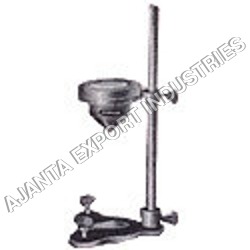
Specification: Flow up Viscometer different viscosity range for measuring the relative consistency during the manufacture and use of points varnishes.
| Type | Viscosity(Range) (Approx) | Use For |
| B-2 | Up to 0.5 stock | Spirit Lacquers |
| B-3 | 0.5-1.2 | Heavy Liquids |
| B-4 | 0.5-2.5 | Heavy Liquids |
| B-5 | 1.5-5.0 | Heavy Liquids |
Precise and Versatile Viscosity MeasurementThis laboratory viscometer accurately measures a broad viscosity range from 10 to 2,000,000 mPas, catering to a diverse array of liquid samples. Equipped with four interchangeable spindles and digital control, it delivers results in under 10 seconds, making it suitable for time-sensitive laboratory and hospital workflows.
Durable Construction and User-Friendly DesignManufactured using high-grade stainless steel and borosilicate glass, this viscometer is both durable and safe for handling a variety of samples. The LCD digital display provides clear readings, while intuitive digital controls simplify operation. Its compact, portable form factor ensures easy relocation across different workstations.
Advanced Features for Reliable TestingSupporting a USB interface for seamless data output, this viscometer allows direct transfer of test results to computers or storage devices. The optional heating attachment expands temperature resistance up to 150C, supporting complex testing environments. Consistent accuracy (1.0% F.S.) and low power consumption make it ideal for demanding laboratory settings.
FAQ's of Viscometer:
Q: How does the viscometer operate and what types of samples can it analyze?
A: The rotational viscometer works by rotating a spindle within the liquid sample and measuring the resistance to determine viscosity. It accommodates a wide viscosity range (10-2,000,000 mPas), making it suitable for various solutions, including oils, polymers, and biological fluids commonly encountered in laboratory and hospital applications.
Q: What is the process for setting up and using the viscometer in a laboratory?
A: To use the viscometer, select the appropriate spindle, attach it to the instrument, and pour your sample into the measuring container. Use the digital control panel to select testing parameters such as speed (0.3-60 rpm) and temperature range (5C to 60C), then read results on the LCD display. Data can be exported via the USB interface for further analysis.
Q: When should the viscometer's optional heating attachment be utilized?
A: The optional heating attachment should be employed when testing samples that require elevated temperatures for accurate viscosity measurements or when temperature-sensitive materials need precise thermal control, supporting tests up to 150C.
Q: Where can this viscometer be effectively used?
A: This viscometer is designed for use in laboratories and hospitals, but its portable and robust construction also allows deployment in research centers and quality control departments across industries, especially where portable and accurate measurements are necessary.
Q: What are the key benefits of using this viscometer for laboratory analysis?
A: Key benefits include its extensive viscosity measuring range, rapid response time, digital accuracy, robust construction from stainless steel and borosilicate glass, portability, and the ability to document results via a USB output. These features ensure reliability, ease of use, and precise measurement for quality control and research.
Q: How does the viscometer ensure accuracy and reproducibility of results?
A: The instrument utilizes digital control for consistent spindle speed, a calibrated measurement system with an accuracy of 1.0% (F.S.), and precise temperature maintenance. These aspects combined ensure high accuracy and reproducibility across multiple measurements.
Q: What is the recommended maintenance process for the viscometer?
A: Routine maintenance involves cleaning the spindles and measuring container after each use, checking for wear on stainless steel and glass surfaces, and ensuring the USB data output ports are kept free of dust. Regular calibration checks help maintain measurement accuracy over time.







 English
 Spanish
 French
 German
 Italian
 Chinese (Simplified)
 Japanese
 Korean
 Arabic
 Portuguese



 Send Inquiry

