Product Description
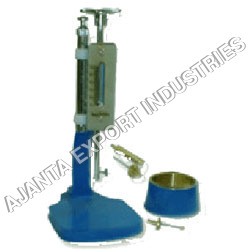
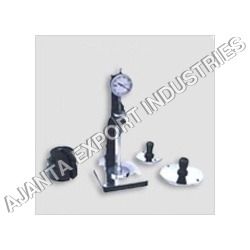
For determining the normal consistency and setting times of cement and A class limes. Consist of a metallic frame bearing a movable rod with cap at one end and a Vicat Mould 80 mm in Dia 5 mm at the base 70 mm 5 mm at the top and 40 mm 0.2 mm high and with a glass base plate, consistency plunger, initial and final setting needles in a nice jeweler case. Complete with dash pot to facilitate the gentle lowering of the needle.High-Quality Brass and Steel ConstructionThe Vicat Needle features a polished brass base plate alongside a mild steel body, ensuring exceptional durability and resistance to corrosion. Its high-quality construction makes it ideal for rigorous laboratory applications. This device is designed to stand up to frequent use without compromising measurement accuracy, providing consistent results over time.
Precise Measurement for Cement TestingWith scale graduations from 0 to 50 mm and a needle/plunger designed for specific testing requirements, the Vicat Needle enables precise determination of cement standard consistency and setting times. The vertical movement of the needle assembly, controlled by an intuitive release button, supports accurate and repeatable test performance.
Comprehensive Accessories IncludedTo offer a complete testing solution, the Vicat Needle comes with a mould, glass plate, and a sturdy carrying case. These accessories streamline the process, making it convenient to prepare, conduct, and store your testing equipment, whether you are in a laboratory, hospital, or field environment.
FAQ's of Vicat Needle:
Q: How is the Vicat Needle used to determine the setting time of cement?
A: The Vicat Needle is used by preparing a paste of cement and water, placing it into the mould on the glass plate, and then lowering the needle or plunger onto the sample using the vertical adjustment and release button. The depth of penetration is measured using the graduated scale to assess consistency and setting times as per standard protocols.
Q: What materials make up the Vicat Needle and its base plate?
A: The main body of the Vicat Needle is constructed from durable mild steel, while the base plate is made from polished brass, which offers both strength and corrosion resistance, ideal for long-term laboratory use.
Q: When should the Vicat Needle be used in cement testing?
A: The Vicat Needle should be used during quality control procedures to evaluate the standard consistency and initial or final setting times of cement. This ensures the cement meets necessary specifications before application in construction projects.
Q: Where can the Vicat Needle be operated?
A: The Vicat Needle is suitable for operation in laboratory and hospital environments where cement testing is required. Its portable case also allows for easy transportation and use in field testing scenarios.
Q: What is the process for adjusting the needle assembly on the Vicat Needle?
A: To adjust the needle assembly, you use the vertical movement mechanism, which is controlled by a release button. This allows for smooth and precise movement to set the needle or plunger at the necessary starting position for each test.
Q: What are the benefits of using a corrosion-resistant Vicat Needle?
A: A corrosion-resistant Vicat Needle ensures reliable performance and longevity, even in humid or chemically aggressive laboratory conditions. This reduces maintenance needs and keeps testing results accurate over time.







 English
 Spanish
 French
 German
 Italian
 Chinese (Simplified)
 Japanese
 Korean
 Arabic
 Portuguese


 Send Inquiry

