Product Description
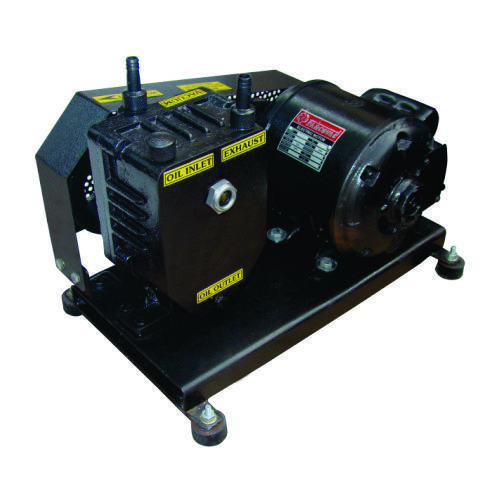
Vacuum Pump Single Stage
Vacuum pump single stage Oil sealed, air cooled, V-belt driven and mounted on base plate with belt guard etc. With motor 220 volts AC single phase.
We have the speciality in the manufacturing of high vacuum pumps. The material and technology used in such pumps is latest and gives high performance in all types of laboratory use with special high quality motor for hours of service, property coupled with and on base.
Displacement Motor H.P. AC
Litre/Min Single phase
32 0.25 hp
50 0.25 hp
75 0.50 hp
100 0.50 hp
150 1/2 hp
200 1/2 hp
OPTIONAL FOR VACUUM PUMPS SINGLE STAGE
Non-returnable value 1.
Air Blast.
Precision and PerformanceDesigned for laboratory applications, this single stage vacuum pump delivers an ultimate vacuum of 5 Pascal and operates at a speed of 30 L/min. Its aluminum alloy housing ensures durability, while the efficient oil-sealed system maintains optimal performance. The low noise operation makes it suitable for both small and large lab environments.
Versatile ApplicationsWith a capacity to handle 32-200 liters per day, this vacuum pump suits various laboratory processes requiring reliable vacuum generation. Its working temperature range from 5C to 60C ensures stability in diverse conditions, making it a practical tool for scientific and industrial use alike.
User-Centric DesignEase of use is prioritized with features such as a 1/4 inch SAE inlet port, straightforward oil maintenance, and compact dimensions (350 x 135 x 240 mm). The pump weighs only 12 kg, making it simple to move or reconfigure within your workspace as needs evolve.
FAQ's of Vacuum Pump Single Stage:
Q: How do I properly set up and operate the single stage vacuum pump in my laboratory?
A: To set up, place the pump on a stable surface, connect the 1/4 inch SAE inlet port to your system, and ensure the oil reservoir is filled to the correct 220 mL level. Connect to a 220V/50 Hz power supply before switching the pump on. Always monitor oil levels and keep the pump within the 5C to 60C working temperature range for optimal performance.
Q: What maintenance is required for the vacuum pump to ensure reliable operation?
A: Regularly check and replace the oil to maintain the oil-sealed system, ensuring optimal vacuum and preventing contamination. Inspect the aluminum housing and inlet port for debris or wear, and confirm the noise level stays below 60 dB. Clean external surfaces and confirm the tightness of all connections during scheduled maintenance.
Q: When should the oil be replaced in the vacuum pump, and what type should I use?
A: It's recommended to replace the oil every 200 hours of operation or sooner if it appears contaminated (darker or cloudy). Always use high-quality vacuum pump oil compatible with oil-sealed laboratory pumps for best results.
Q: Where is this vacuum pump best utilized, and what are its primary applications?
A: This pump is ideally suited for laboratory environments, including chemistry, physics, and material science labs that require precise vacuum conditions for processes such as filtration, degassing, or distillation. Its capacity and construction make it versatile for various research and industrial tasks.
Q: What is the typical process for achieving vacuum using this pump?
A: Once the pump is connected and powered, it draws air and vapors out of your system via the 1/4 inch SAE inlet, rapidly reducing pressure to reach the ultimate vacuum level of 5 Pascal. The oil-sealed design ensures consistent pressure and prevents backflow of contaminants.
Q: How does this vacuum pump benefit laboratory operations?
A: Its efficient design allows fast evacuation (30 L/min), quiet operation (<60 dB), and easy maintenance, increasing productivity and minimizing disruptions. The compact size and lightweight build make it easy to integrate into any laboratory setting.







 English
 Spanish
 French
 German
 Italian
 Chinese (Simplified)
 Japanese
 Korean
 Arabic
 Portuguese


 Send Inquiry

