Product Description
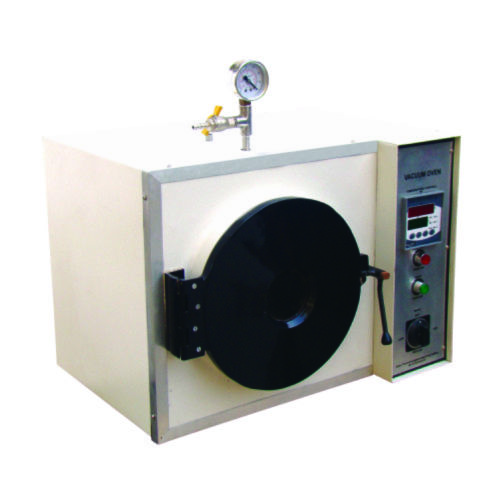
Heat treated Glass window leaves clear contentview.
Selection of Temp controller Thermostatic 50above ambient to 150 c.
Inside chamber made of stainless steel andoutside mild steel. Temperature range from 50 to 130C without vacuum pump.Thermostatic control with glass door to work 220/230 volts AC Supply.
Size Capacity(Approx.)
10''x12'' 12 ltrs.
12''x12'' 24 ltrs.
12''x24'' 40 ltrs.
Technical Specification
| Capacity | 12ltr |
| Brand | AjantaExport |
| Temperature | 50-130deg. |
| Material | Stainless Steel |
| Door Type | Double Door |
| Country of Origin | Made in India |
OPTIONAL FOR VACUUM OVEN (ROUND)
Please add extra for thefollowing options:
a) Digital temp. Indicator-cum-Controller.
b) Microprocessor PID digital temp. Indicator-cum-controllerwith timer.
c) Digital temp. Indicator.
Advanced Uniform Heating SystemEmploying nichrome wire embedded in heating plates, the oven ensures even distribution of heat throughout the chamber. This technology promotes consistency during drying, degassing, and heat treatment processes, minimizing hot spots and preserving sample integrity whether in laboratory or industrial environments.
Robust Stainless Steel ConstructionThe internal chamber comprises high-grade stainless steel (304/316), while the exterior utilizes mild steel with a powder-coated finish. This dual-layer, glass wool-insulated design enhances durability and safety, maintaining optimal temperatures and reliability for prolonged operation under demanding conditions.
Intuitive Digital Controls & Safety FeaturesA user-friendly digital PID temperature controller allows for precise temperature management, with an adjustable timer (0-999 minutes) for process flexibility. Safety is amplified with over-temperature cut-out, indicator lamps, and a clearly visible vacuum gauge, ensuring secure and monitored operation at all times.
FAQ's of Vacuum Oven Round:
Q: How does the vacuum oven achieve uniform heating?
A: The oven utilizes nichrome wire embedded within the heating plates, providing even heat distribution across the chamber. This ensures consistent sample processing and prevents temperature variations, which is essential for accurate drying and treatment outcomes.
Q: What applications is the vacuum oven suitable for?
A: This vacuum oven is primarily used for drying, degassing, and heat treatment of samples under vacuum. It is ideal for laboratories, research facilities, and industrial processes where precise heating and maintaining a controlled atmosphere are vital.
Q: When should I use the vacuum oven's vacuum feature during operation?
A: The vacuum feature should be engaged when low-pressure conditions are necessary to prevent oxidation, accelerate drying, or degas samples. Engaging the vacuum before or during the heating cycle ensures optimal process results, especially for sensitive or reactive materials.
Q: Where can I monitor and control the vacuum and temperature levels?
A: Vacuum levels are easily observed via the front-mounted analog vacuum gauge, while temperature is managed and displayed on the digital PID control panel. This allows precise, real-time monitoring and adjustments directly on the oven's front panel.
Q: What benefits does using a round vacuum oven provide over conventional ovens?
A: A round vacuum oven offers improved heat distribution, better sealing for vacuum integrity, and a compact footprint. These features provide enhanced drying efficiency, reduce contamination, and make the oven well-suited for sensitive or high-purity applications.
Q: How do I connect a vacuum pump to the oven?
A: A dedicated rear port is provided for vacuum pump attachment. Securely connect the vacuum hose to this port and ensure airtight fittings to maintain the proper vacuum level during operation.
Q: What safety features are integrated in this vacuum oven?
A: The oven is equipped with an over-temperature safety cut-out, indicator lamps for operational status, a toughened glass viewing window, vacuum-tight fittings, and airtight heavy-duty clamps to ensure safe and reliable usage throughout each cycle.







 English
 Spanish
 French
 German
 Italian
 Chinese (Simplified)
 Japanese
 Korean
 Arabic
 Portuguese


 Send Inquiry

