Product Description
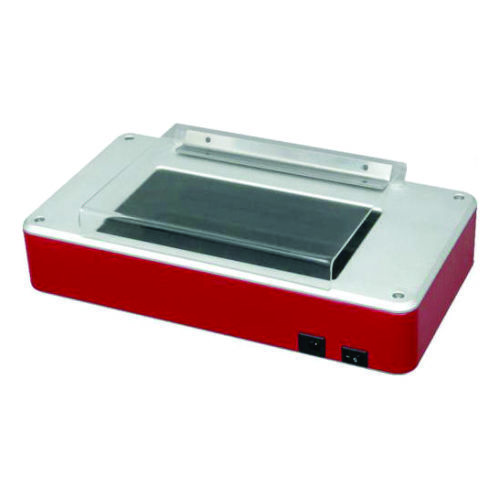
An ultraviolet (UV)Transilluminator is a standard piece or equipment used in life science laboratories used forvisualization of target DNA's and proteins. The UV Transilluminator works byexisting high levels of UV radiation through the viewing surface. The keyapplication for a UV transillumination is for Visualization of DNA and proteinagros4 and polyacrylomide gels after electrophoresis gels can be directly placedonto the UV transilluminator , wavelength will vary on your particularapplication.
Transilluminator Model BTI-20 isrequired in biotechnology, Molecular Biology applications in colleges,Universities, Research Institutes.
These are college model transilluminatorhaving detection limit minimum 200ng. Specfications is given on left hand side.
SPECIFICATION of UV Transilluminator
Wavelength 365 nm with suitable filter
No. of U.V Tubes 8 imported
Wattage 8 watts
Detection limit 200ng
Blue Plate Area 210x210 mm approx.
Body MSwith powder coated
UV Protection Shield Yes
Advanced UV Visualization TechnologyThis UV Transilluminator leverages premium fluorescent tube technology and offers flexibility among three UV wavelengths-302 nm standard, with 254 nm or 365 nm as options. The design provides uniform illumination across a robust UV-protected acrylic surface, supporting precise visualization in molecular biology workflows, particularly for nucleic acid detection in agarose gels.
User-Focused Design for Laboratory SafetyA hinged, UV safety cover and temperature resistance up to 50C ensure protection for users, while an easy-to-clean aluminum body enhances durability. The manual control switch makes usage straightforward, and the compact, rectangular design conserves valuable lab bench space. The instrument satisfies laboratory needs for safe, reliable, and consistent gel visualization.
FAQ's of UV Transilluminator:
Q: How is the UV Transilluminator operated in a laboratory setting?
A: The UV Transilluminator is powered directly using a manual switch and connects to a 220-240V AC power supply. Simply place your gel on the UV-protected acrylic surface, close the hinged safety cover, and activate the UV lamps to visualize nucleic acids with uniform illumination.
Q: What safety features are included with this UV Transilluminator?
A: The instrument comes equipped with a hinged UV safety cover and is constructed with UV-protected glass and acrylic surfaces to protect users from harmful UV exposure. Over-temperature protection further safeguards against accidental overheating during extended use.
Q: When is it appropriate to use the UV Transilluminator?
A: Use the transilluminator after running agarose gel electrophoresis when you need to observe nucleic acid samples. Its uniform lighting and selectable wavelengths make it ideal for both routine and specialized laboratory analysis tasks in molecular biology.
Q: Where can this UV Transilluminator be installed?
A: This compact device is suitable for installation on standard laboratory benches, especially in molecular biology, genetics, and research facilities. Its lightweight design and moderate footprint make it versatile for various laboratory environments.
Q: What maintenance steps are necessary for reliable operation?
A: Regularly clean the acrylic viewing surface using non-abrasive materials to avoid scratches. Ensure that the safety cover and UV tubes remain dust-free. Avoid exposure to chemicals that may damage the aluminum body or the UV-protected glass.
Q: What are the benefits of using this transilluminator for gel imaging?
A: This device offers uniform UV light exposure for clear nucleic acid visualization, temperature resilience up to 50C, and enhanced safety. The system is user-friendly, compact, easy to clean, and provides multiple wavelength options for various applications, optimizing lab efficiency.







 English
 Spanish
 French
 German
 Italian
 Chinese (Simplified)
 Japanese
 Korean
 Arabic
 Portuguese



 Send Inquiry

