Product Description
We manufacture the units as per the specifications of our customers. The units are produced using good quality raw materials for a longer life of the product.
The Apparatus Consists Of The Following :
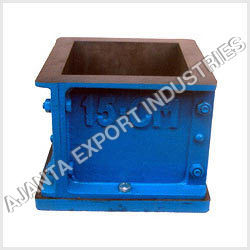
- A gunmetal mould which is 100mm dia. x 127.3mm height x 1000ml volume
- An extension collar 100mm dia. x 60mm high
- Drainage base plate having a recess for a porous stone with an outlet valve
- Metallic clamping ring
- Drainage cap (Top plate with a recess for a porous stone and fitted with an inlet valve and an air release valve)
- Dummy plate to serve as a false bottom curing compaction
- Porous stone for drainage base plate
- Porous stone for drainage cap
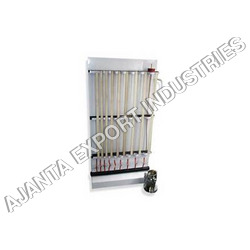
- Set of three glass stand pipes in approximate sizes of 6 mm dia., 10mm dia. and 20mm dia. mounted on a stand
- 3 meter long rubber connecting tube with pinch cock.
Reliable Soil Permeability TestingThis Universal Permeability Apparatus provides consistent and accurate assessment of soil permeability using both constant and variable head tests. With precise control valves and metric scale standpipes, users can easily manage and observe water flow through soil specimens. The set's robust construction ensures reliable testing over time, making it indispensable for educational and industry laboratories alike.
Versatile, Easy-to-Use DesignFeaturing a manual operation system, this apparatus enables straightforward testing for both beginners and professionals. The aluminum frame offers stability, while included accessories like the compacting rammer and glass top simplify sample preparation and observation. Suitable for diverse research needs, the unit is lightweight yet durable, enhancing portability and longevity.
FAQ's of Universal Permeability Apparatus:
Q: How is the Universal Permeability Apparatus used to test soil permeability?
A: To test soil permeability, prepare a soil specimen of 100 mm diameter and 127.3 mm height. Position it between the glass top and base plate, then use the compacting rammer for proper sample compaction. Water is passed through the specimen using the standpipe tubes, and the rate of flow is observed through the metre scales. Both constant and variable head methods can be performed with the apparatus.
Q: What are the benefits of using this apparatus in a laboratory setting?
A: This apparatus offers accurate and repeatable results for permeability tests. Its heavy-duty anodized aluminum construction ensures durability, while its precise control valves and diverse tube diameters allow for flexible experimental conditions. The apparatus is manual, making it cost-effective and suitable for both educational demonstrations and professional research.
Q: When should I choose constant head versus variable head permeability tests?
A: Constant head tests are typically used for coarse-grained soils like sands and gravels, where water can flow freely. Variable head tests are better suited for fine-grained soils such as silts and clays. The Universal Permeability Apparatus conveniently supports both methods, expanding its range of testing applications.
Q: Where can this apparatus be effectively utilized?
A: This apparatus is ideal for use in soil mechanics and geotechnical laboratories, educational institutions, research centers, and civil engineering consultancies across India. Its portability and ease of use also make it suitable for field laboratories, wherever soil permeability testing is required.
Q: What process is followed to set up the standpipe system for testing?
A: To set up the standpipe system, first select the appropriate tube diameter for your test. Fill the selected standpipe with water and open its dedicated control valve to allow water to flow through the soil specimen. Monitor the water head using the clearly marked metre scales, adjusting as needed to maintain precise test conditions.
Q: How does the design of the apparatus enhance its performance and durability?
A: The frame is made from heavy-duty anodized aluminum, resisting corrosion and providing structural stability during use. The included accessories, such as the glass top and overflow pipe, support efficient and clean operation, while the control valves ensure precise water regulation throughout each test.







 English
 Spanish
 French
 German
 Italian
 Chinese (Simplified)
 Japanese
 Korean
 Arabic
 Portuguese


 Send Inquiry

