Product Description
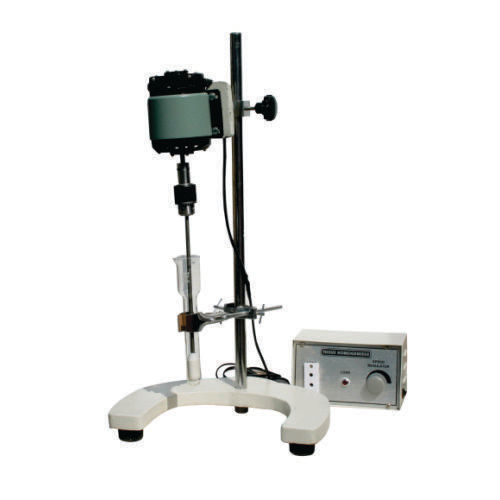
It is a multipurpose unit,suitable for low speed homogenisation of tissue and also small volume low speedstirring applications. Pulley driven low speed operation provides high torquefor grinding homogenizing of animal or vegetable tissues.
1/20 H.P. motor speed controlled.Complete with tissue homogenizing cup and rod is made of stainless steel.
Type of Motor : AC/DC Universal
Horse Power : 1/20
Maximum Speed : 4000RPM
Capacity (Dependency ofViscosity) : 6-8 Litres
Stirring Shaft Length : 6mm
Stirring Shaft Length : 300mm
Propeller sweep & type : 38mm, 3 Bladed
Stainless Steel for shaft &propeller : S.S Grade 304
Shaft & motor coupling : Self centering Chuck
Height of retort stands : 600mm
Capacity
For 25ml vessel
For 50ml vessel
For 100ml vessel
Efficient Sample ProcessingCapable of homogenizing up to 24 x 2 ml tubes per run, this tissue homogenizer saves valuable time and enhances laboratory productivity. Its adjustable speed (0-3000 rpm) and bead-beating principle ensure thorough disruption and homogenization of even tough samples.
Advanced Safety and UsabilityThe homogenizer is equipped with a transparent acrylic lid featuring a secure safety lock and an automatic stop if the lid is opened during operation. These features, along with its intuitive microprocessor controls and LED display, ensure user safety and straightforward operation.
Robust Design for Diverse ApplicationsConstructed with stainless steel and ABS housing, this bench-top homogenizer is durable and easy to maintain. Suitable for a wide range of applications, from biotechnology research to diagnostics, it is designed to withstand routine use in busy laboratory environments.
FAQ's of Tissue Homogenizer:
Q: How does the tissue homogenizer operate to effectively disrupt biological samples?
A: The homogenizer uses a bead beating principle, where samples are agitated with beads at high speeds (0-3000 rpm), facilitating efficient disruption and homogenization of a wide range of samples like tissue, plant material, and microbial cultures.
Q: What types of samples can be processed using this tissue homogenizer?
A: This instrument is suitable for homogenizing tissues, plants, yeast, bacteria, fungi, and spores, making it highly versatile for molecular biology, biochemistry, and microbiology laboratories.
Q: When should I use the safety lid lock feature on the tissue homogenizer?
A: The safety lid lock automatically engages during operation to prevent accidental opening. This ensures user protection and should always be in use whenever the machine is running or about to start a run.
Q: Where is this tissue homogenizer commonly applied?
A: It is widely used in research institutes, diagnostics labs, biotech companies, and industrial settings across India where efficient sample disruption and homogenization are required.
Q: What is the process for adjusting speed and monitoring run parameters?
A: The homogenizer offers variable speed control (0-3000 rpm) via a microprocessor-controlled interface. All operational parameters, including time and speed, are clearly displayed on an LED digital screen for easy monitoring and adjustment.
Q: How do the construction materials benefit daily laboratory usage?
A: With stainless steel and ABS housing, the homogenizer is both durable and resistant to corrosion, supporting rigorous daily laboratory work while ensuring easy cleaning and long-term reliability.
Q: What are the main benefits of using this tissue homogenizer over manual methods?
A: Compared to manual homogenization, this bench-top device offers higher throughput, improved consistency, reduced processing time, and enhanced safety for users, allowing reliable and reproducible results in less time.







 English
 Spanish
 French
 German
 Italian
 Chinese (Simplified)
 Japanese
 Korean
 Arabic
 Portuguese


 Send Inquiry

