Product Description
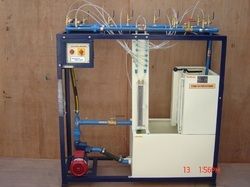
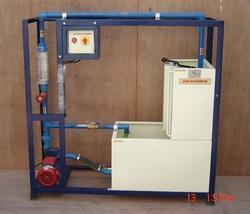
The set up consists of a 1/2 bend and elbow, a sudden expansion & sudden contraction fitting from 15mm to 25mm, ball valve and gate valve. Pressure tapings are provided at inlet and outlet of these fittings under test. A differential manometer fitted in the line gives pressure loss of individual fittings. Present set-up is self-contained water re-circulating unit, provided with a sump tank and a centrifugal pump etc. Flow control valve and by-pass valve are fitted in water line to conduct the experiment on different flow rates. Flow rate of water is measured with the help of measuring tank and stop watch.
Experiments
- To determine loss of head in the fittings at various water flow rates
- To measure the loss coefficient for the pipe fittings
Utilities Required
- Electric supply 0.5 kW, 220V AC, Single Phase
- Water supply Tap water connection ” BSP Distilled water @ 60 liters (optional)
- Floor Area with Drain facility
Comprehensive Pipe Fitting ExperimentsThe apparatus allows users to experimentally investigate the behavior of fluids when passing through sudden changes in pipe diameter. This helps in understanding energy losses and flow characteristics essential for fluid dynamics studies.
Durable Stainless Steel ConstructionCrafted entirely from stainless steel, the equipment resists corrosion and ensures longevity even with frequent use. Its structure guarantees accurate experiments and safety within laboratory environments.
Versatile Laboratory ApplicationOperating efficiently on voltages from 110 to 220V, the system accommodates various laboratory infrastructures. Its weight and build make installation straightforward, whether in educational or research facilities.
FAQ's of Study of Pipe Fittings, Sudden Enlargement & Contraction App:
Q: How is the pipe fitting study apparatus used in laboratories?
A: The apparatus is set up to simulate fluid flow through pipes with sudden enlargement or contraction. By observing pressure and flow rate changes, students and researchers analyze energy losses and hydraulic behavior in controlled experiments.
Q: What are the main benefits of using a stainless steel pipe fitting study system?
A: Stainless steel provides durability, corrosion resistance, and stable performance, ensuring experimental accuracy and a long service life even under repeated exposure to water or laboratory chemicals.
Q: When should this equipment be implemented in laboratory settings?
A: This apparatus is best used in educational courses or research sessions focusing on fluid mechanics, hydraulics, and civil or mechanical engineering topics, providing hands-on experience with theoretical concepts.
Q: Where can this laboratory apparatus be installed?
A: The equipment is suitable for engineering labs, research institutes, vocational training centers, and universities across India. Its voltage compatibility and manageable weight make it adaptable to numerous lab setups.
Q: What is the process of studying sudden enlargement and contraction in this device?
A: Fluid is passed through pipes with intentional changes in diameter. Sensors and gauges measure the impact of these changes on fluid pressure and flow, enabling detailed analysis of energy losses due to abrupt transitions.
Q: How does the apparatus support academic learning?
A: By providing a tangible demonstration of fluid mechanics principles, the system bridges the gap between theoretical learning and practical application, making complex concepts more accessible to students.
Q: What is the typical weight of the equipment, and why does it matter?
A: The apparatus weighs between 10 and 40 kilograms, balancing robustness and portability. This allows for secure operation while remaining easy to reposition or store as needed.







 English
 Spanish
 French
 German
 Italian
 Chinese (Simplified)
 Japanese
 Korean
 Arabic
 Portuguese


 Send Inquiry

