Product Description
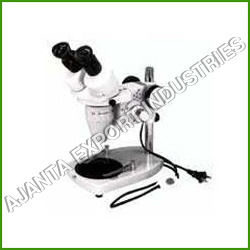
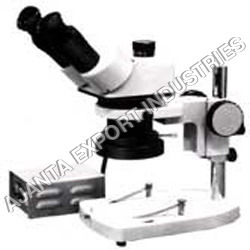
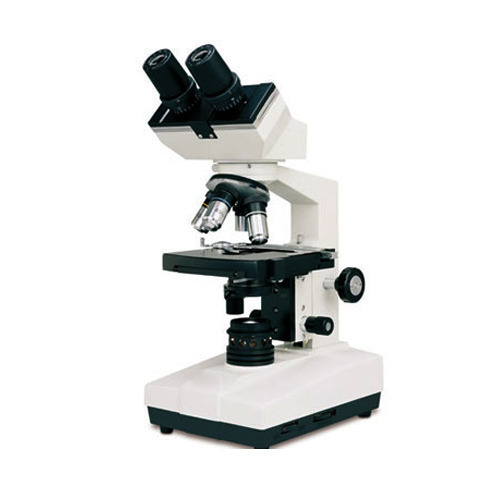
Accustomed to serves our clients to the maximum level we have been fabricating a wide range of Universal Stereo Microscopes. Equipped with one eye piece lens this microscope has a single magnification power of 20X and relies in ambient light for illumination. Primarily used for reflected light observations where the light bounces off the specimen and to the user of the eye.Built for Precision and DurabilityThe stereo microscope's die-cast metal frame with anti-rust finish promises exceptional longevity, while its heavy rectangular base offers superior stability during observation. The 45 inclined and 360 rotatable binocular head enhances user comfort, accommodating different working environments. All optical elements are coated for anti-fungal protection, ensuring reliable performance in varied temperature and humidity conditions.
Versatile Illumination and Expanded CompatibilityBright LED illumination-both incident and transmitted-provides optimal lighting for examining a broad range of samples. Independent switches let you tailor the lighting to your needs. Compatible with a variety of camera adapters and eyepiece brands, the microscope supports digital imaging when required, making it future-ready for educational, industrial, or research setups.
Designed for Clarity and Easy OperationPaired wide-field WF10X eyepieces and achromatic objectives yield a clear, immersive 3D image. The coarse adjustment rack and pinion focusing system guarantees smooth, precise focusing. With a working distance of 80-100 mm and an adjustable interpupillary range, users experience comfortable and strain-free viewing. Included stage plates and clips accommodate diverse specimen types.
FAQ's of Stereo Microscopes:
Q: How does the anti-rust and anti-fungal coating benefit the stereo microscope?
A: The combination of die-cast metal with an anti-rust finish and anti-fungal coatings on optical elements ensures long-term durability and maintains high clarity of observation. These features protect the microscope from corrosion and fungal growth, even in humid environments, extending its usable lifespan.
Q: What is the operational process for illuminating samples with this microscope?
A: The microscope is equipped with built-in LED incident (top) and transmitted (bottom) lighting, each controlled by independent switches. This arrangement allows users to adjust light intensity and direction according to the specific needs of their sample, providing optimized contrast and detail in various study applications.
Q: Where can this stereo microscope be used effectively?
A: Thanks to its robust construction, energy-efficient illumination, and universal compatibility, this microscope is suitable for educational institutions, research laboratories, industrial inspection, and fieldwork. Its dust cover and anti-fungal features make it especially practical in settings exposed to dust and fluctuating humidity.
Q: What is the process for attaching a digital camera to the microscope?
A: The microscope features a standard eyepiece interface compatible with optional camera adapters. To capture images or videos, simply attach a suitable digital camera to the adapter in place of an eyepiece. Consult the camera and adapter's instructions for optimal setup.
Q: How does the 3D visualization enhance usage?
A: The specially designed binocular head, paired objectives, and wide-field eyepieces allow users to observe specimens in three dimensions, offering greater depth perception than flat images. This is especially valuable in applications like dissection, quality control, and material studies.
Q: What are the benefits of the heavy rectangular base and adjustable focusing system?
A: The heavy rectangular base prevents tipping and vibration during use, promoting stability for precise observations. The rack and pinion focusing system allows users to smoothly and accurately adjust the stage height for sharp focus, accommodating specimens of varying sizes.
Q: When should the spare parts, such as eyepieces or illuminator, be replaced?
A: Spare parts like eyepieces, stage plates, objectives, or illuminators should be replaced if you notice visible damage, reduced image quality, or inconsistent lighting. Regular maintenance and cleaning help extend their service life, but timely replacement ensures consistent performance.







 English
 Spanish
 French
 German
 Italian
 Chinese (Simplified)
 Japanese
 Korean
 Arabic
 Portuguese


 Send Inquiry

