Product Description
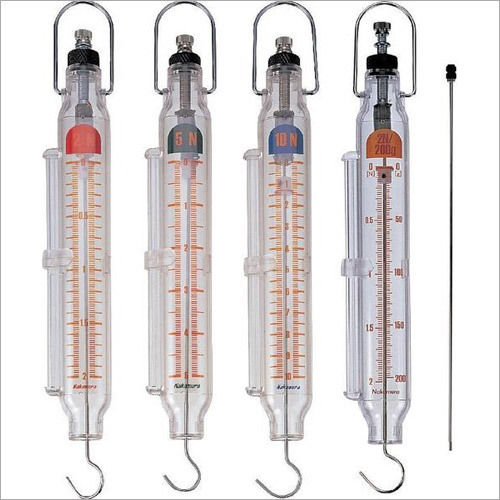
SPRING BALANCE, NEWTON SCALE
Same as PHY-122, but with scales in newtons.
PHY-122.1 0 to 1 N x 0.01 N
PHY-122.2 0 to 2 N x 0.02 N
PHY-122.3 0 to 5 N x 0.05 N
PHY-122.4 0 to 10 N x 0.1 N
PHY-122.5 0 to 20 N x 0.2 N
Accurate and Reliable Force MeasurementWith its robust stainless steel and plastic construction, the Spring Balance Newton Scale delivers consistent force readings, critical for laboratory and educational experiments. The analog scale, with precise graduations and easy-to-read markings, ensures students and professionals alike obtain accurate measurements every time.
Designed for Practical Laboratory UseThis spring balance is engineered for straightforward operation and versatility. Its transparent body and colored end caps make it both appealing and functional. Whether used to demonstrate gravitational force, friction, or tension, the dual hooks provide flexible setup in various experimental scenarios.
Durable, Low-Maintenance ConstructionBuilt from high-quality rust-resistant metals and sturdy plastic, the Spring Balance Newton Scale is crafted for long-lasting performance. Simple maintenance-just a dry cloth clean, avoiding harsh chemicals-ensures a prolonged lifespan and continued accuracy, making it a preferred choice for repeated laboratory use.
FAQ's of SPRING BALANCE, NEWTON SCALE:
Q: How do I use the Spring Balance Newton Scale to measure force in a laboratory setting?
A: Suspend the scale using the top ring and attach the object or weight to the bottom load hook. The internal spring stretches according to the applied force, and the analog scale indicates the force measurement in Newtons. Ensure the scale is vertically aligned for accurate readings.
Q: What are the main benefits of using a Spring Balance Newton Scale for educational purposes?
A: This instrument offers a hands-on approach to understanding force measurement and Newton's laws, allowing students to visualize and directly engage with fundamental physics concepts. Its manual operation and clear graduations make learning both interactive and accessible.
Q: When should I select specific scale ranges, such as 1N, 5N, or 20N, for my measurements?
A: Choose a scale range based on the expected magnitude of force you plan to measure. Use lower ranges (e.g., 1N) for small forces or delicate objects, and higher ranges (e.g., 10N or 20N) for heavier loads to ensure measurements stay within the device's capacity and retain accuracy.
Q: Where is the Spring Balance Newton Scale typically used?
A: This instrument is widely utilized in educational laboratories, physics classrooms, and research settings. It is suitable for both basic demonstrations and advanced experimental setups involving the measurement of tension, friction, or gravity-related forces.
Q: What process should I follow to maintain and store the Spring Balance Newton Scale?
A: Wipe the scale with a dry cloth after use to remove dust or residues. Avoid exposure to strong acids, bases, or high temperatures, and store the device in its protective sleeve or box to prevent damage and ensure lasting precision.
Q: What materials are used in the construction of this spring balance, and why are they advantageous?
A: The scale features a transparent plastic tube, sturdy nickel-plated steel hooks, and a durable metal spring. These materials ensure rust resistance, lightweight portability, and long-term reliability, making the instrument suitable for frequent laboratory use.







 English
 Spanish
 French
 German
 Italian
 Chinese (Simplified)
 Japanese
 Korean
 Arabic
 Portuguese



 Send Inquiry

