Product Description
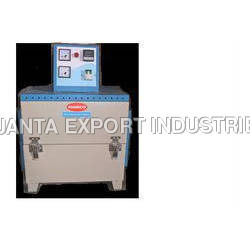
We manufacture split tube furnace having dia from 25 mm to maximum 150mm. Tem temperature range will be 5 degree above ambient to 1200 degree C. The inside chamber will be made of quartz tube or recrystallized alumina tube. Temperature will be controlled by pid temp. Controller with thyristor/SSR power pack. Precision Heating for Advanced ResearchDesigned for critical laboratory processes, the Split Tube Furnace delivers rapid, accurate, and uniform heating reaching up to 1200C in as little as 30-60 minutes. Its digital PID temperature controller ensures fine-tuned performance, while a 5C uniformity across the heated length and 1C accuracy at steady state guarantee dependable outcomes for heat treatment, sintering, and annealing tasks.
Versatile Design for Easy OperationThe hinged split-tube design allows easy access for tube insertion, removal, and maintenance. With customizable tube lengths from 300 mm to 1200 mm and compatibility with a range of tube diameters (50-150 mm), adaptation for specific experimental protocols is simple. Choose between benchtop or floor-standing models with built-in or external controllers to optimize your workspace.
Safety and Energy Efficiency Built-InThe furnace is engineered for user safety with an over-temperature alarm, safety lockout, and circuit breaker. High-density ceramic fiber insulation maximizes energy efficiency and minimizes heat loss. With optional air cooling and robust electrical protections, the furnace not only delivers consistent results but safeguards personnel and lab environments.
FAQ's of Split Tube Furnace:
Q: How do I choose the appropriate tube length and diameter for my application?
A: Select the tube dimensions based on the sample size and the specific process requirements. Tube lengths are available from 300 mm to 1200 mm, with internal diameters from 50 to 150 mm, allowing you to match your experimental volume and heating uniformity needs.
Q: What heating elements are used, and how do they affect temperature capability?
A: The furnace offers Kanthal (FeCrAl alloy) or Silicon Carbide (SiC) rod options as heating elements. Kanthal elements are ideal for applications up to 1200C, while SiC rods extend the upper temperature range up to 1600C, providing flexibility for different thermal processes.
Q: How does the hinged split-tube mechanism benefit laboratory users?
A: The split-tube design, featuring a hinged opening, enables effortless tube installation, removal, and cleaning. This reduces downtime between experiments and minimizes the risk of accidental tube damage, enhancing usability and convenience in busy laboratories.
Q: When should I use an air fan cooling system instead of natural cooling?
A: An air fan cooling system is recommended for faster cooldown cycles or when handling temperature-sensitive materials. Natural air cooling suffices for standard operations but can be upgraded to fan-assisted cooling for improved laboratory efficiency and safety.
Q: Where can the split tube furnace be installed in the lab?
A: The furnace supports both benchtop and floor-standing mounting options. Choose benchtop models for space-constrained labs or floor-standing configurations for larger setups and heavy-duty usage. Built-in or external control boxes accommodate various laboratory layouts.
Q: What safety measures are included in this furnace?
A: Essential safety features include an over-temperature alarm, safety lockout, and circuit breaker. Additionally, robust refractory insulation and safety interlocks further enhance safe operation and compliance with CE and ISO standards.
Q: What are the main benefits of using this split tube furnace for laboratory research?
A: Users benefit from quick heat-up times, uniform temperature distribution, precise control, energy-efficient insulation, versatile compatibility with quartz or alumina tubes, and advanced safety features, making it ideal for demanding research and industrial applications.







 English
 Spanish
 French
 German
 Italian
 Chinese (Simplified)
 Japanese
 Korean
 Arabic
 Portuguese


 Send Inquiry

