Product Description
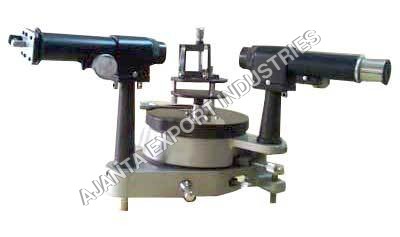
We bring forth our comprehensive array of Spectrometer which is designed to give high performance. We manufacture this Spectrometer in compliance with norms of international standards. Due to its durability, reliably, efficacy and accuracy it is highly demanded by the clients.
Features:-
| Designed to give maximum accuracy |
| Heavy cast iron base fitted with levelling screw |
| Protected circle is read by two opposite vernier |
| Collimator tube and telescope are adjusted to the collinear |
| Objective and the collinear lenses are achromatic |
| Ramsden eye-piece with fine cross wire |
| Rack and pinion movements are provided to both the telescope collimator |
Applications:-
| Medical institutes |
| Observatories |
| Labs |
| Research centre |
| Hospital |
Precision and Control for Optical AnalysisThis spectrometer provides 1 minute of arc accuracy and features dual vernier scales, enabling fine rotational measurements. The collimator and telescope are optimized for laboratory tasks, ensuring you can analyze light spectra with outstanding precision. Its manual controls allow for 360 rotation, facilitating comprehensive observational studies.
Engineered for Educational and Research UseConstructed from high-quality stainless steel, cast iron, and optical glass, this instrument is built to endure frequent laboratory usage. Its corrosion-resistant paint guarantees a long operational life, and the manual operation requires no external power, making it suitable for educational settings and field research.
FAQ's of Spectrometer:
Q: How do I use the spectrometer for measuring the spectral lines of light sources?
A: Place your standard laboratory prism on the adjustable holder of the prism table. Align the collimator and telescope using the graduated scale to focus the incoming light (within 400-700 nm) onto the table. Rotate the telescope and prism table manually to view different spectral lines, using the dual vernier for precise angular measurements.
Q: What materials is this spectrometer made from, and why are they beneficial?
A: This spectrometer is constructed using stainless steel for key components, a cast iron base for stability, and optical-quality glass for the collimator and telescope lenses. These materials ensure durability, resistance to corrosion, excellent optical performance, and long-term reliability in various laboratory conditions.
Q: When is calibration necessary for the spectrometer, and how is it done?
A: Calibration should be performed before initial use, after relocating the instrument, or if inconsistent readings are observed. To calibrate, use known spectral lines (such as a mercury lamp), align the prism and telescope, and adjust the scales until the observed lines match reference values.
Q: Where can this spectrometer be used?
A: This spectrometer is suitable for laboratory environments in educational institutions, research facilities, and industrial settings. Its robust design and manual operation also allow for field use when electrical power is not available.
Q: What is the process for adjusting the prism holder and telescope focus?
A: Loosen the adjustment screws on the prism holder to secure your prism. Use the fine focusing mechanisms on both the collimator and telescope to bring the image of the slit into sharp focus, ensuring optimal measurement accuracy for optical analysis.
Q: What are the main benefits of using this spectrometer in educational laboratories?
A: The spectrometer offers hands-on learning for students by illustrating fundamental concepts in optics, such as dispersion and angular measurement. Its manual controls and precise graduated scales foster deeper understanding and skill development for laboratory techniques.
Q: How does the spectrometer's graduated circular scale improve measurement accuracy?
A: The instrument's graduated circular scale, combined with dual vernier readings at 1' precision, enables highly accurate determination of angular differences. This enhances the reliability of wavelength and spectral line measurements during experiments.







 English
 Spanish
 French
 German
 Italian
 Chinese (Simplified)
 Japanese
 Korean
 Arabic
 Portuguese


 Send Inquiry

